
The picturesque small village of Rijkhoven was mostly famous for having been the command centre of the Teutonic Order.
Now, it’s 16th-century castle will go down in history as the place where European leaders finally dared to openly talk about a multi-speed EU.
The mood for the ‘informal retreat’ was set by weeks of mutual mud-slinging and confronting ideas – punctuated by industry-issued open-letters describing doomsday scenarios. (Think Europe’s chemical industry’s fears of complete shut down.)
While key leaders such as German Chancellor Friedrich Merz and Italy’s prime minister Georgia Meloni, advocated deregulation and trade liberalization – French President Emmanual Macron pressed for ‘European preference’ in certain industries.
European Commission President Ursula von der Leyen took her fair share from the blame-game, attacking member states and national rules, ‘we must also look at the national level … the extra layers of national legislation that just make businesses’ lives harder and create new barriers in our single market’. Her key thoughts rallied around ‘dysfunction among the national capitals’.
Member states think differently.
According to Germany’s Merz, the ball for cutting red tape is firmly in Brussels’s court, “I know that these institutions in the European Union are not as fast as they should be. We are fighting against the machinery which is working and working, and producing and producing new regulations.”
Harsh words from a rule-obsessed German.
The informal retreat – chaired by António Costa, President of the European Council – was snugly fit between a cozier, 19+ meeting and the annual international security jamboree in Munich.
As it happened on many such meetings in the past, the governments acknowledged that Europe urgently needed to change its whole existence if it didn’t want to lose the intensifying international competition.
Thus, the meeting focused on a wide array of ideas from boosting Europe’s competitiveness, industrial strength, and strategic autonomy.
Key areas included a simplification agenda (to appease member states), a promise to move further towards a single market (a quiet nod towards the Commission in admittance of the still existing fragmentation), investment mobilization and allowing a ‘degree of company consolidation’ in some sectors to achieve the necessary levels of investment and innovation.
Among others.
So far, it fits into the usual modus vivendi.
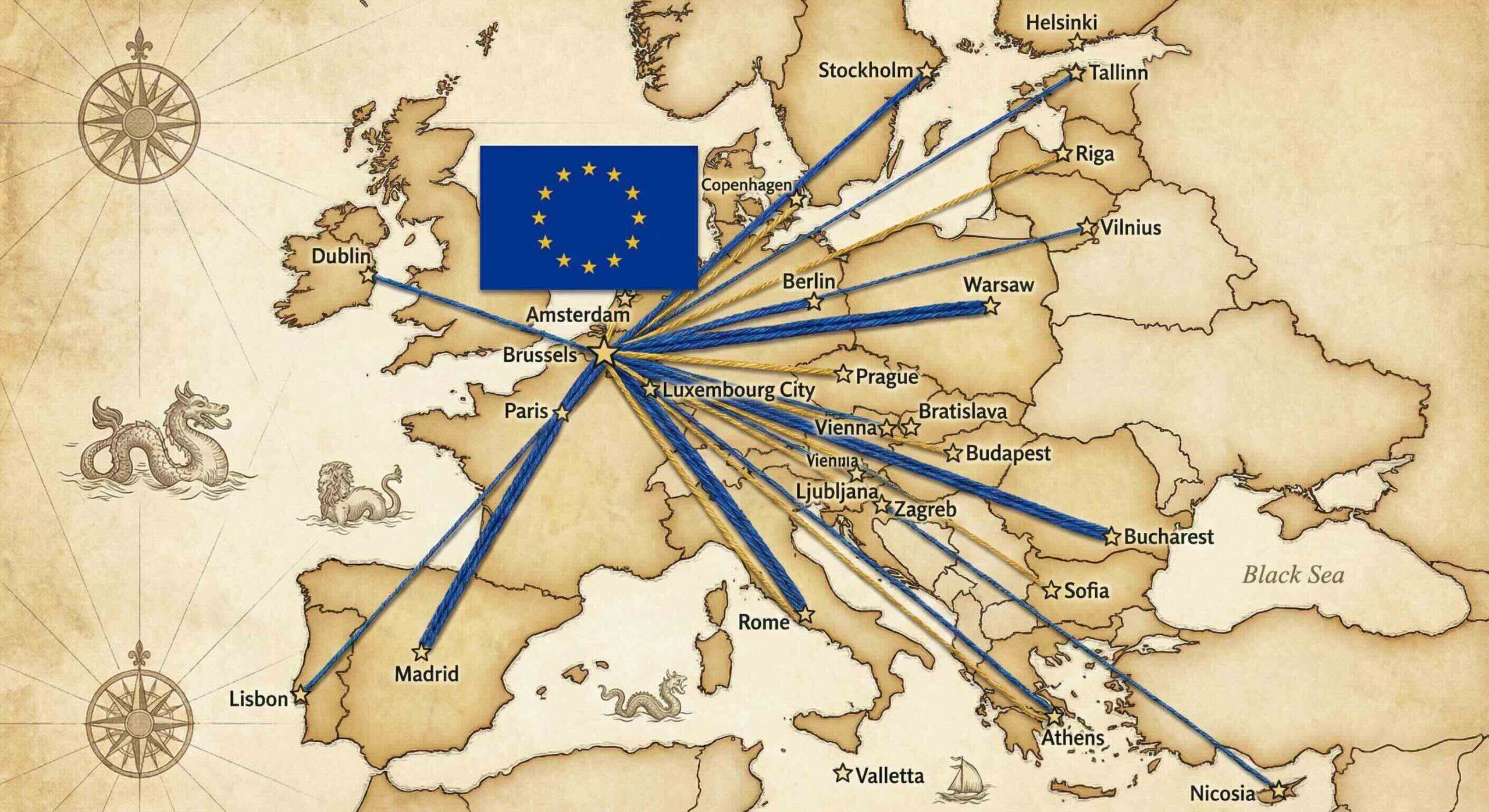
The novelty is that, driven by a ‘shared sense of urgency’, a group of member states, lead by France, Germany and Italy (the old core of the European Economic Community) adopted the idea of a multi-speed EU. In circulation for decades but always pushed to the side with the hope of a ‘unified Europe’.
The plans will be finalized (supposedly) by the European Council meeting in March, but the idea that was accepted during the ‘strategic brainstorming’ – as President António Costa described the meeting – is simple: groups of member states will sign up to initiatives in smaller groups.
This will, supposedly ‘bring new energy’ – because President Costa promised that ‘in 2026, Europe will deliver. We did on defence last year, we will on competitiveness this year.”
What was less talked about is the economic reality of finding financing for the EU’s bold plans. Simplification and mobilizing private assets are a good start, but it is unlikely to counter the billions Beijing spends – even a far cry from the amount indicated by the Draghi report. Draghi put the amount necessary to relaunch Europe at around €800 billion a year – experts at the European Central Bank put this amount at €1,200 billion. Annually. Until 2031.
Which raises the question of the feasibility of the project, especially amidst the ongoing war in Ukraine, let alone Ukraine’s possible EU accession in 2027.


