
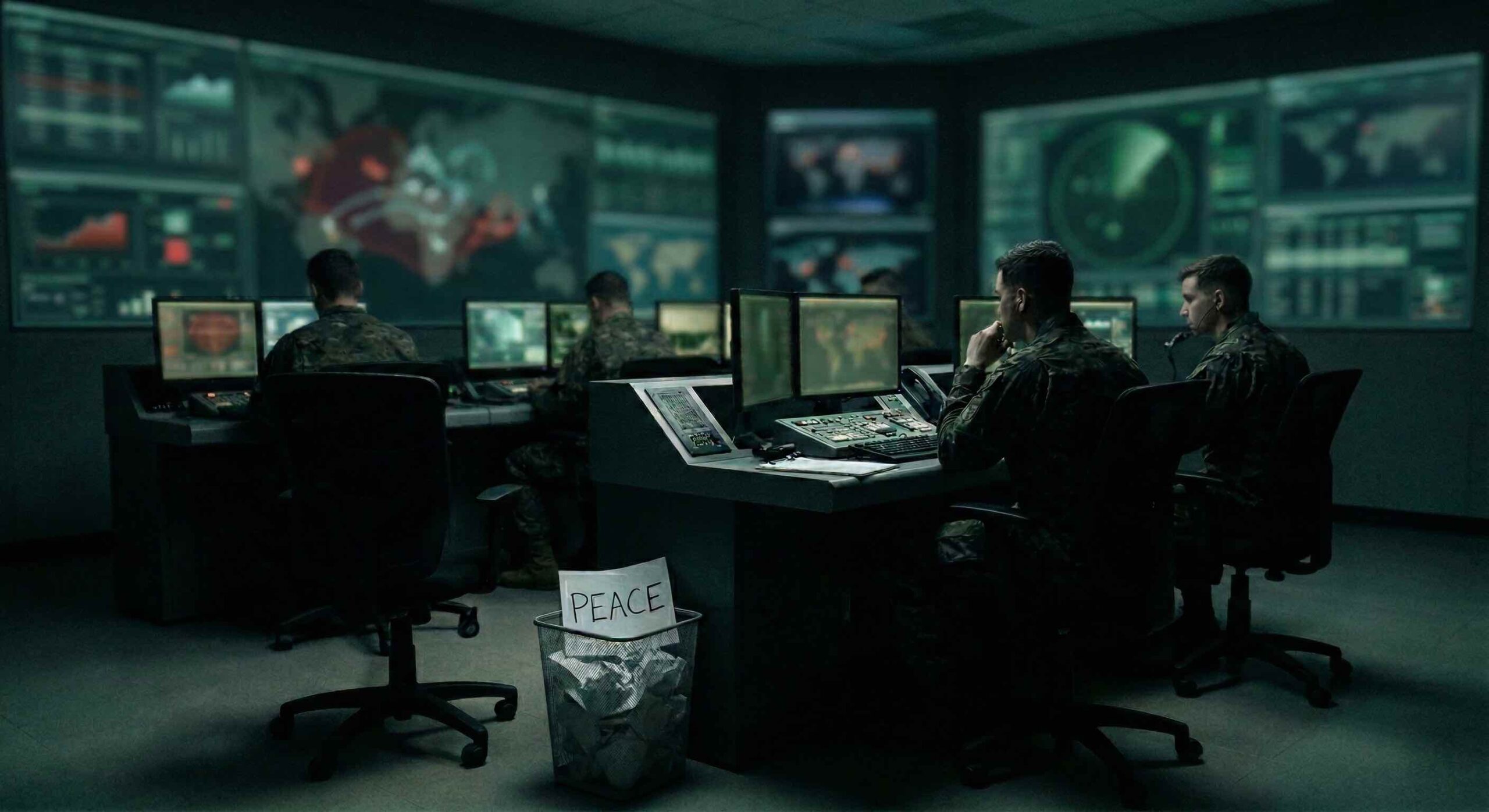
The information about splits within the Ukrainian peace talks team, recently published by The Economist, is nothing but the good old Russian narrative, Ukrainian President Volodymyr Zelenskyy said in a comment on the allegations that divisions between the supporters of the current and the former heads of presidential office – Kyrylo Budanov and Andriy Yermak – have emerged around the issue of what would be in Ukraine’s best interest: a swift peace with Russia under Washington’s umbrella which would be Budanov’s goal or, the continuation of both the negotiations and the fights from the position of strenght, according to the idea of Yermak who is less optimistic if just peace could be reached with Moscow. President Zelenskyy appears to be balancing between these two wings while having his own ideas on a potential peace agreement, The Economist claims.
The Ukrainian president has not only denied the information of The Economist about the Ukrainian negotiators being divided but also stressed he was doing everything he can ’to ensure that the various channels of communication between Ukrainians and Americans, or even between Russians and Ukrainians, are all in the same format.’ adding that, what The Economist says sounds quite offensive and that the paper just repeats a Russian narrative about divisions within the Ukrainian delegation during negotiations.
Meanwhile, a new round of trilateral peace talks involving Ukraine, Russia and the US took place in Switzerland on 17-18 February, but, despite even security advisers from the UK, France, Germany and Italy have arrived in Geneva, the negotiations did not bring any result.
To fully understand the course of the recent events, it is worth digging deep down to the roots and touching the issue of another war Moscow was waging in the 1990s, the first and the second war in Chechnia.
As the Russia-Ukraine war has entered its fourth year, both sides increasingly turn to a tactic the Kremlin mastered during the Chechen wars. Today, not only Moscow but also Kyiv frequently engage in the same practice, which is explained in detail by former FSB officer Alexander Litvinenko in his book ’Blowing Up Russia: The Secret Plot to Bring Back KGB Terror (originally published in New York in 2002), describing how the FSB, the successor of the KGB fabricated terrorist attacks and launched a war.
In his own book, Litvinenko, who himself died of radioactive poisoning, an assassination commited by the Russian intelligence services in the UK in 2006, also points to the fact that despite the fact that there were a number of political figures in Russia who were in favour of concluding a peace agreement with the Chechens, they routinely became victims of assassinations organized by law enforcement agencies and, as a result, negotiations were not only stalled but prooved impossible to continue. It should be noted that the special services conducted these attacks partly in accordance with top-level government orders and partly because it was in their own interests. The government and the intelligence services had one thing in common: peace did not serve their interests, and they were therefore willing to go as far as murder to prevent it.
The situation seems just the same these days when assassinations escalate in Ukraine’s and Russia’s so-called shadow war.
Just weeks ahead of the negotiations in Geneva, one of the highest ranking and best secured military commander was attacked in Moscow. On 6 February, First Deputy Head of Russia’s Main Intelligence Directorate (GRU) Vladimir Alexeyev was the target of an assissanation attempt in Moscow. The Russian authorities blamed Ukraine for the incident, which Kyiv, of course, denied.
Although the talks eventually took place in Switzerland, the attempted attack stalled the negotiation process. Despite the assassination attempt remained unsuccessful, the peace talks have been derailed.
Zelenskyy said in an interview with Financial Times on 24 February, the 4th anniversary of the full-scale war, that Russia has no intention of ending the war and that Vladimir Putin is merely playing games with US President Donald Trump in an attempt to use the negotiation process to weaken Ukraine’s position. He also stressed that Putin is only creating the illusion of being ready for peace.
Although Donald Trump believes Zelenskyy has to move and reach a deal to end the Russo-Ukrainian war, he seems to be completely alone with this idea considering that neither Putin nor Zelenskyy would be interested in signing a peace agreement right now. In addition, US President is fully and truly convinced that Moscow really wants to make a deal. That is why he urges Zelenskyy ’to move’, otherwise he is going to miss ’a great opportunity’.
But one thing should be added in order to correctly understand what Trump’s word really mean, namely that he needs a result in his peacemaking efforts by the summer when the US congressional elections take place. In addition, Trump hosts the 250th anniversary celebrations of American independence on July 4, that is why he is pushing for a deal before this date. With the aim of achieving Trump’s political goals, the US and the Ukrainian negotiators discussed the possibility of signing a peace agreement in March and holding elections in Ukraine in May.
One concern among Kyiv’s allies is that Putin may agree to a ceasefire that would allow Trump to claim success in ending the war, while Russia continued a campaign of sabotage, hybrid warfare or election interference aimed at destabilizing Ukraine, Bloomberg warns.
Among all the statements by political leaders, it was former Ukrainian President Petro Poroshenko who expressed the most clear-sighted opinion on the war and Putin, saying that he fears, Russia is playing Zelenskyy and Trump.
’Trump thinks Putin is trading with him and trying to get better peace terms. This isn’t true. Putin isn’t trading. He has an absolutely different understanding.’, Poroshenko said. He is also convinced that with the issue of territorial concessions, Putin’s goal in Ukraine is to wreck the country’s unity as ’he is a KGB officer. He’s a specialist in this kind of thing,’, he said in an interview with POLITICO after the Munich Security Conference.
The stalemate in the peace talks is likely to serve the interests of both sides of the war. Today, we can see no signs that Putin is willing to budge from his maximalist positions nor that Zelenskyy is ready to make territorial consessions to Russia, i. e. to cede the Donbas.
What they are both prepared to do, however, is to disrupt the peace talks pushed by the US with acts of terrorism. Putin has been practicing this tactic for a long time, and although Zelenskyy is a newcomer in this field, he has also gained considerable experience in recent years, as the above-mentioned assassination attempt against GRU chief Vladimir Alexeyev is, after all, just one of a number of similar incidents.
Just think of the attacks such as the assassination of Andriy Parubiy, a serving member of Ukraine’s Parliament and its former speaker in Lviv last summer, the deadly attack on Darya Dugina, the daughter of Russian nationalist ideologue Alexander Dugin in 2022, assassination attempts on Russian propagandists such as Vladlen Tatarsky and Zakhar Prilepin, as well as pro-Russian Ukrainians, including former member of parliament Ilya Kiva in 2023. Russian Lieutenant General Igor Kirillov was murdered in Moscow in late 2024. In April 2025, car bombs killed another lieutenant general, Yaroslav Moskalik, who was deputy chief of operations in Russia’s General Staff. The number of similar attacks is almost endless.
Analysis of over 150 assassination attempts in both Ukraine and Russia since 2022 show how assassination attepts have surged, according to Armed Conflict Location & Event Data’s (ACLED) website. It is important to emphasize that, according to official data, Russia appears to be in a catch-up mode in this so-called shadow war.
The evolution of the assassination campaign within Russia points to Ukraine’s willingness to go to great lengths to disrupt Russia’s war machine, ACLED experts says adding that the escalating assassinations point to a normalization of the practice.
Against the backdrop of Ukraine’s planned fast-track EU membership, EU leaders should ask themselves whether they really want to admit to the family a country that routinely carries out assassinations both on its own territory and abroad.
As the duel of assassinations is likely to continue and given that three rounds of trilateral talks so far this year in Abu Dhabi and Geneva have failed to bring any results, Trump’s frustration may reach the point where he is willing to let Ukraine’s issue go and be satisfied with Venezuela and the Gaza settlement. This may well be enough for the 250th anniversary celebrations of American independence.
Last but not least, it is worth recalling US envoy Steve Witkoff’s words saying ’It really is a silly war. They are fighting over, they are arguing this territory. Everyone throws the word dignity around, but what does dignity get you if you have that amount of killing there?’
He is absolutely right.


