
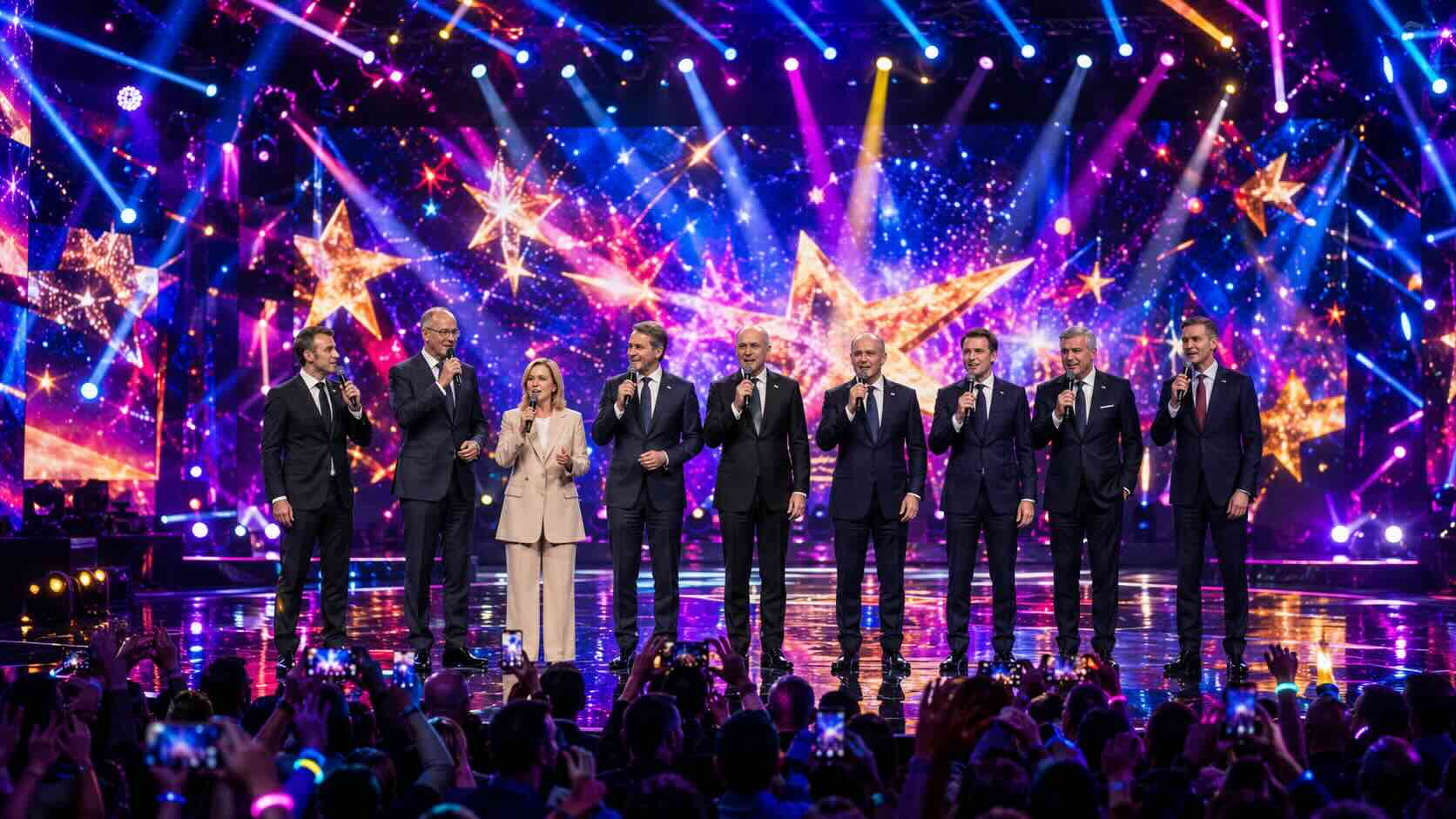
Once upon a time, there was a quaint little idea called Eurovision.
The date was 1956.
It was in the early days of European integration that the European Broadcasting Union (EBU) launched the contest to bring countries closer together (and to help advance television technology).
The dream was simple and quite optimistic: combine a shared stage, a few songs, a little glitter and it screams harmonious coexistence after two horrible world wars.
It mostly did, with a few glitches.
Fast forward to 2026.
That idea feels somewhat outdated now, though some things remained the same.
The Eurovision is still in Vienna, celebrating its 70th anniversary.
But the contest is no longer treated as a music festival first and a political battleground second.
The order has been reversed – and the Eurovision became a political message board.
Five countries are boycotting this year’s contest over Israel’s participation, while the EBU kept Israel in the lineup after its internal decision-making process.
The result is a competition that is still marketed as unity through song, while being discussed as if it were a summit of hostile states (only with better costumes).
Shocking? Not quite.
For a while, the same ritual has repeated itself year after year.
The organizers announce that they want “music” and “togetherness”, but all the participants ask whether the voting system is rigged, whether the costumes are offensive, whether the lyrics are political, whether the host country is too this or not enough that, and whether someone’s delegation has made a statement, liked a post, waved a flag, or breathed in the wrong ideological direction.
The current boycott wave is the clearest sign that Eurovision has become less a festival than a proxy arena. A proof that even a cultural event cannot escape the tension of unresolved history.
Ironically, the people who insist most loudly that Eurovision must remain “apolitical” are often the same people who turn every decision to include or exclude, into a political statement.
Eurovision was invented precisely because Europe had spent far too much time demonstrating, at very great cost, what happens when politics becomes the only language in the room.
The contest was supposed to offer a counter-image: shared media, shared performance, shared visibility. And a lot of theatrics, of course.
The modern Eurovision’s problem is not that politics has “entered” the contest. Politics has been there for a very long time.
It’s always been visible in voting blocs, in diplomatic gestures, in withdrawals, in host-country tensions, in stage messages and in the myriad small debates (like who gets to stand on that stage in the first place).
The difference now is that the political layer has become so thick that the musical layer sometimes feels like a decorative excuse.
The spirit of the original idea survives in flashes: a silly chorus that somehow unites strangers, or a song in a language many viewers do not understand but still feel.
But each year that spirit is tested by the irresistible human urge to convert art into proof of moral superiority.
The boycotts make this especially painful because they are not just absences.
When non-participation becomes content itself, a not-even-veiled message – then absence becomes a performance. Part of the show.
And thus Eurovision becomes the perfect European machine: deeply sincere, endlessly performative and forever torn between the dream of connection and the habit of fragmentation.
A little like the EU in itself.
Born from a spark, a dream of a different future – yet getting bogged down by hundreds of years of grievances and conflicting national interests.
A mirror reflecting a Europe that still loves the idea of cultural unity but cannot stop converting culture into a weapon.
Yet, culture cannot solve all the continent’s problems – it’s wishful thinking.
And we lose more than a silly contest when we try.
The original purpose of Eurovision was not perfection. It was not political innocence. It was a modest act of cultural faith. It invited the continent to sit together, however awkwardly, and listen.


