
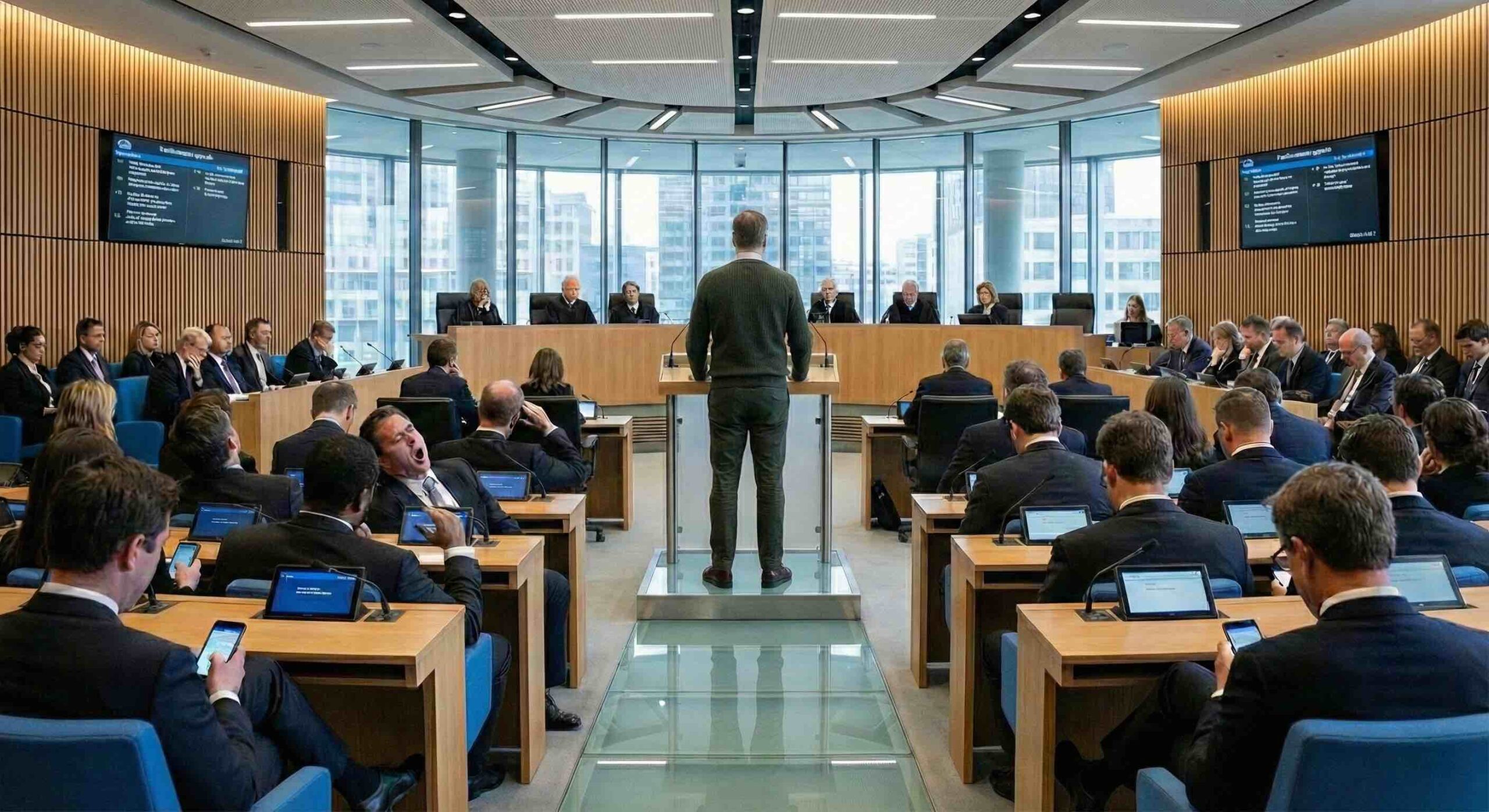
If ingratitude were an export commodity, President Volodymyr Zelensky’s Davos 2026 speech would qualify as a flagship product.
Before delivering it, he dutifully performed his favorite pre-show routine: hinting that he might not attend at all, ostensibly to avoid drawing attention to himself. This well-rehearsed “reluctant presence” tactic is designed to inflate expectations, intensify media focus, and ensure that when he finally appears, the spotlight is bright enough to maximize impact.
Standing on a European stage, financed by European taxpayers, protected by European security guarantees, Zelensky once again used the moment not to thank support, but to deliver his preferred message to Europe: you are weak and failing me.
The message and the full show are a familiar ritual by now.
Europe sends money, weapons, fuel subsidies, political cover, and diplomatic muscle.
Zelensky responds by humiliating Europe for not sending enough, fast enough, loudly enough, etc. Hundreds of billions of euros buy tanks and ammunition, European financial guarantees keep Ukrainian institutions alive — but not even a sentence of public gratitude.
At Davos, Zelensky didn’t sound like the leader of a nation fighting for survival.
He sounded like a permanently dissatisfied child throwing a tantrum to Mommy for slow service. A child who never has courage to the same tantrum in front of Daddy – sitting silent and confused in Daddy’s office on the rare occasions he’s allowed in.
Apparently, in Zelensky’s worldview, Europe exists in a state of permanent moral indebtedness.
It must pay, applaud, escalate, give up own interests, suffer economic pain and remain silent — all at once. Any hesitation or debate is betrayal. Any request for oversight is treated as an insult to Ukrainian suffering.
Europe is not a partner. It is a resource. Mommy is always there and manages everything, as in any spoiled child’s imagination.
European voters struggling with inflation, energy prices, and budget deficits apparently have no standing in this conversation. They are expected to finance Ukraine indefinitely, without asking awkward questions about efficiency, how long, for what, corruption or where the money actually goes.
Perhaps the most impressive part of Zelensky’s performance this time is what he forgot to mention.
When President Trump openly entertained forcing a settlement deeply unfavorable to Ukraine, it was European governments that scrambled to protect Ukraine’s position in Washington.
Europe spent political capital, strained alliances, and absorbed domestic backlash to keep Ukraine from being pushed into a humiliating deal.
This was not symbolic support; it was concrete, risky, and expensive.
From European point of view the more favorable deal would be to finish the money burning war in Ukraine, follow the U.S. lead instead of risking further conflicts with Washington, make deals with Moscow and get back cheap energy.
Instead, European leaders inexplicably chose the more expensive and painful path, which favored Ukraine.
Zelensky’s speech arrived after this period.
Yet, it came with a negative focus on Europe and not a negative word about Washington or President Trump. At Davos, none of the above was mentioned, only the criticism. Europe was portrayed as weak, passive, and dependent — despite having carried Ukraine financially while the United States debated its next move.
Amnesia, in this case, is a diplomatic strategy.
Zelensky’s tone rests on one assumption: that Ukraine’s suffering grants its leadership unlimited credit and permanent immunity from criticism.
Aid is not cooperation; it is obligation. Questions about corruption or mismanagement are waved away as distractions, or worse, as moral failures by those asking them.
This would be easier to accept if Ukraine were not historically (in)famous for corruption (and organized crime), Zelensky’s closest friends wouldn’t be involved in recent corruption scandals and hadn’t earned fortunes during the war.
Yet each concern raised by European institutions is met not with reassurance, but irritation. The message is clear: send the money, trust blindly, and do not expect transparency to keep pace.
Zelensky’s defenders claim this rhetoric is necessary — that constant pressure keeps Europe engaged.
Perhaps. But pressure without respect eventually turns allies into liabilities and solidarity into resentment.
Publicly humiliating your sponsors may generate applause in activist circles, but it quietly erodes trust among those who actually sign the checks.
The real risk of Zelensky’s Davos performance is not bruised European egos.
It is the assumption that European support is infinite, unconditional, and politically cost-free.
This is the mistake for that Europeans should draw his attention at least once, as the USA did.
History suggests there is no such thing as unlimited support.
Wars become distant, or too long, budgets tighten, public patience erodes, or new conflicts get the focus. And when that happens, speeches full of moral entitlement will not rebuild goodwill and people will remember such humiliating comments.
Zelensky chose an ungrateful path: to treat Europe as an underperforming servant rather than an ally. The message was unmistakable: nothing you do will ever be enough.
It would be nice to know whether European leaders have understood this.
Just like in an abusive relationship. If this is partnership, it is a strange one — where one side pays, apologizes, and endures public scolding, while the other demands more and calls it leadership.
At some point, even the most generous ATM starts asking why it is being insulted by the person withdrawing all the cash.
At some point, every parent feels the need to raise their child to understand how the real world works.
The question is when Mommy will become tired of serving the child and struggling with Daddy at the same time. Especially since, Daddy – maybe understandably – has long lost his patience with this spoiled child and its never-ending requests and illusory desires.
(For the moment, let’s ignore the question whose parenting style would be more beneficial for the child on the long run.)


