
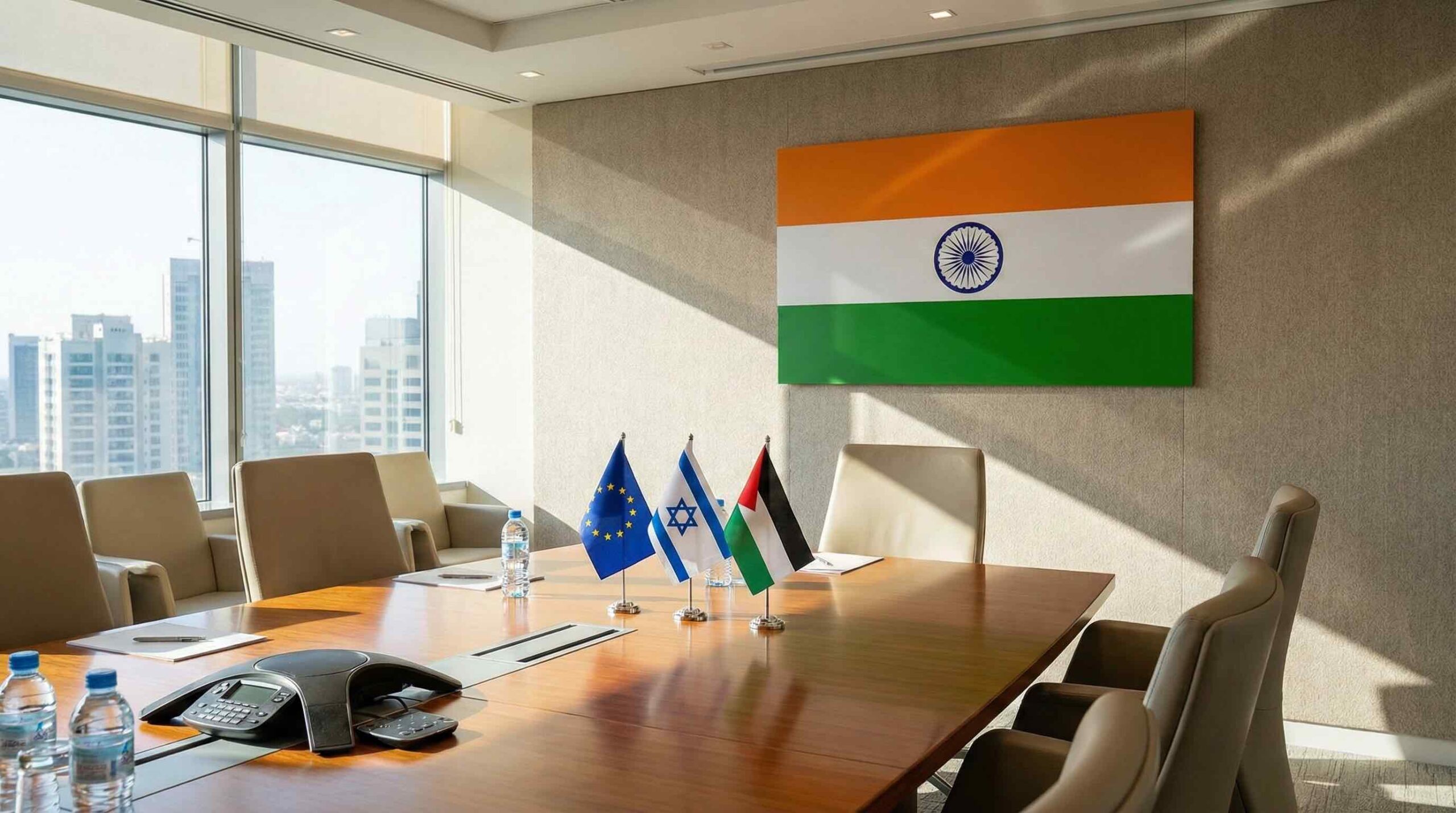
Indian diplomacy has a few busy weeks behind its back.
It started in late January 2026, when India rolled out the red carpet for Arab diplomats.
After a decade-long hiatus, New Delhi hosted the Second India–Arab Foreign Ministers’ Meeting, convening all 22 members of the League of Arab States to sign the “Delhi Declaration.”
Unsurprisingly, the joint statement proclaimed support for a “sovereign, independent and viable State of Palestine”, reaffirming India’s commitment to a just Middle East peace along pre-1967 borders. In other words, India loudly backed the Arab Peace Initiative while remaining studiously noncommittal about Israel.
Cleverly enough, New Delhi balances its status as one of Israel’s largest arms customers with a friendly nod toward Palestinian statehood.
As analysts note, the declaration even avoided ruffling feathers over US-Iran tensions or casting blame on any one side.
The result is the proof that New Delhi mastered the trade of diplomacy.
India gets credit from Arab capitals for championing Palestinian rights and regional stability, and maintains its own arms deals and strategic ties – all under the banner of “peace” and “multilateralism”.
Barely a week later, India scored another diplomatic victory – this time with Brussels.
On Jan. 27, 2026 the EU and India announced the conclusion of a “historic, ambitious” free trade agreement (FTA).
The deal was immediately hailed by Indian officials as a “landmark shift” that will dramatically deepen economic and strategic ties, knitting together two massive markets and promising to double EU exports to India by 2032.
New Delhi’s External Affairs Minister went so far as to call the FTA “not just a trade deal, [but] a platform to expand our cooperation in security, defence, climate action, [and] technology partnerships”.
To translate to plain English: India sweet-talked Europe into cutting tariffs on $4 billion of goods (wine, olive oil, chocolate, pastries) in exchange for virtually nothing beyond friendly words.
The European Council’s press office smugly labeled it a “historic, ambitious and commercially significant” accord. One that secured India’s favor without demanding policy concessions elsewhere.
Meanwhile, across the pond, Washington was busy securing its own slice from the pie.
In a February 2026 press blitz, President Trump claimed he’d clinched a “trade deal” with India that would cut US tariffs from 50 percent to 18 percent after PM Modi agreed to stop buying Russian oil.
The president claimed that Modi had committed to “BUY AMERICAN” (to the tune of $500 billion in purchases!) and to slash all Indian tariffs on US goods.
Modi’s own response? A one-line tweet praising Trump’s leadership and noting that “Made in India” products would see tariffs cut to 18 percent – without mentioning any oil or tech promises.
In fact, India’s Commerce Minister only confirmed that a deal would be signed “shortly,” without giving any details. As economists pointed out, this “agreement” is really just hot air: “It’s no deal, but just a declaration by both leaders when nothing has been signed,” quipped Professor Jayati Ghosh.
In other words, India managed to get Washington to lift punitive tariffs on Indian goods, while writing none of Trump’s demands into stone. Modi even made sure to praise Trump on peace and stability, conveniently sidestepping any mention of oil supply shifts, practically leaving the fate of Russian oil purchases unconfirmed.
Of course, India’s balancing act wouldn’t be complete without strengthening ties with old ally Russia.
It was just before Christmas 2025 that President Modi hosted President Putin with full pomp.
The summit produced the usual declarations of enduring friendship – Modi described Russia as a “guiding star” in their ties – along with deals ranging from fertilizer plants to mutual defense production. President Putin even hinted that Russia stood ready to keep supplying “uninterrupted fuel” to India.
India’s answer was a classic example of diplomatic ballet: its foreign secretary noted that fuel purchases would be decided on “market dynamics” and sanctions concerns.
Behind the scenes, India did reduce its Russian oil imports in late 2025 to avoid sanctions, but, at the same time, publicly New Delhi complains of unfair tariffs on its goods while America continues to buy billions of Russian oil and gas. As one Russian diplomat smirked, “if the US can buy Russia’s (nuclear) fuel, why shouldn’t India?”.
The uncanny balancing act is obvious in Delhi’s playbook: say nice things to both Putin and Trump, and then do whatever suits India.
Or as India’s Defense Secretary recently remarked, “Russia has been our friends through both fair and foul weather” – but India still follows “a policy of strategic autonomy”.
Thus, in the matter of few weeks, New Delhi scored victory points from all sides – a real diplomatic feat and proof of exemplary maneuvering without choosing sides.


