
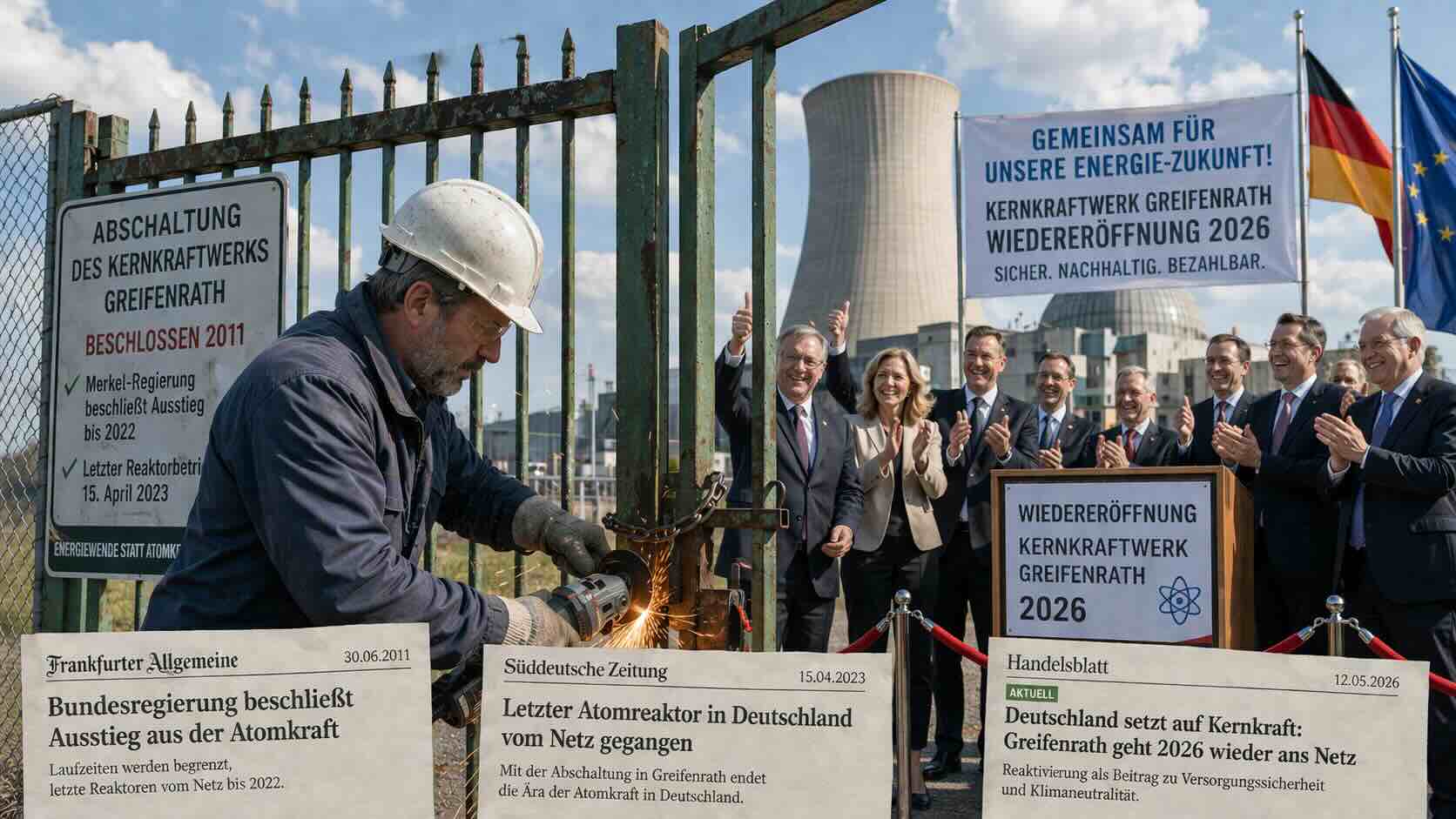
The EU has always had a talent for learning the right lesson sooner or later. Though, usually, only later.
It seems to be the case now, as well.
Policymakers all around Brussels are, with increasing candor, acknowledging that turning away from nuclear energy may not have been the strategic masterstroke it once appeared.
The last in the line was Commission President Ursula von der Leyen, who recently allowed herself a rare moment of Brussels-style change-of-heart and declared that phasing out nuclear energy might have been, shall we say, not entirely optimal.
Most leaders stop short from saying it out loud that, in the great effort to decarbonize and de-risk, Europe sidelined one of the few large-scale, low-carbon energy sources it actually knew how to build – rather, politicians and bureaucrats alike sound cautious ‘maybe’-s.
The turn back then was driven by many factors: public anxiety after the Fukushima incident, political calculation, and a belief that renewables would scale faster than they realistically could.
Add to this a few other issues and nuclear became not only expensive, but politically toxic and, supposedly, obsolete in a future powered by wind, sun … and good intentions.
If and when the (still) unreliable renewables couldn’t deliver – Russian gas, affordable and conveniently piped, filled the gaps. Quietly, but steadily building a different sort of dependency.
In an ideal world, it would have been a bridge fuel – but in the real world, the toll became unbearable the moment disaster struck.
Catastrophe (war) brought not just geopolitical, but economic shocks.
Energy prices surged, industries wobbled, and governments rediscovered the uncomfortable truth that energy policy is less about ideals in isolation and more about the geographical realities and trade-offs under pressure.
Like nuclear a couple of years before, now the label “Russian” became unacceptable, leaving Europe in a rather uncomfortable position. Alas, cutting Russian supplies may have been politically inevitable, even necessary, but it exposed how thin the margin for error had become.
And this is where the nuclear question returns – driven by very practical considerations.
Because for all its drawbacks—high upfront costs, long construction times, and the ever-present shadow of public concern—it does something remarkably unfashionable: it produces large amounts of stable, low-carbon electricity, day and night, rain or shine, geopolitics permitting.
The contrast with renewables isn’t a competition so much as a mismatch of roles.
Wind and solar are essential, but they are variable. Storage helps, grids help, interconnections help—but right now, there are technological constrains that need to be balanced out with something steady and easy-to-control.
The big Iberian Blackout of 2025 was an eye-opener to the built-in vulnerabilities.
A renewables-heavy system is resilient only if the baseline is carefully balanced.
For now, the change (turn) isn’t a dramatic full-stop, rather a cautious, gradual reframing.
Nuclear is referred to only as “part of the mix” or a “complement”. Of course, when it comes to the EU, even such a subtle shift is significant.
The acknowledgement of changing voter expectations (and cost-of-living problems) and geopolitical realities.
It is hard to advocate strategic autonomy and independence when the continent relies heavily on external suppliers to meet its energy demand.
Reliable, domestically produced nuclear power suddenly looks a sensible option.
There is, of course, no simple reset button.
(Re)-building nuclear capacity takes time—often more time than political cycles comfortably allow. The expertise is still there, but it has not been exercised at the scale it once was. Restarting the ‘nuclear field’ is possible, but it requires consistency, investment, and, perhaps most challenging of all, political patience.
The EU’s position is not easy: it’s like adjusting course mid-journey. Luckily (?) the bloc has a vast expertise at ‘course correction’ or ‘recalibration’.
But at least, recognition happened and the lesson got learned. Energy policy cannot be built on ideology alone.
Even if a little late.
And if done well, nuclear energy can become a pragmatic piece of a much larger puzzle.


