
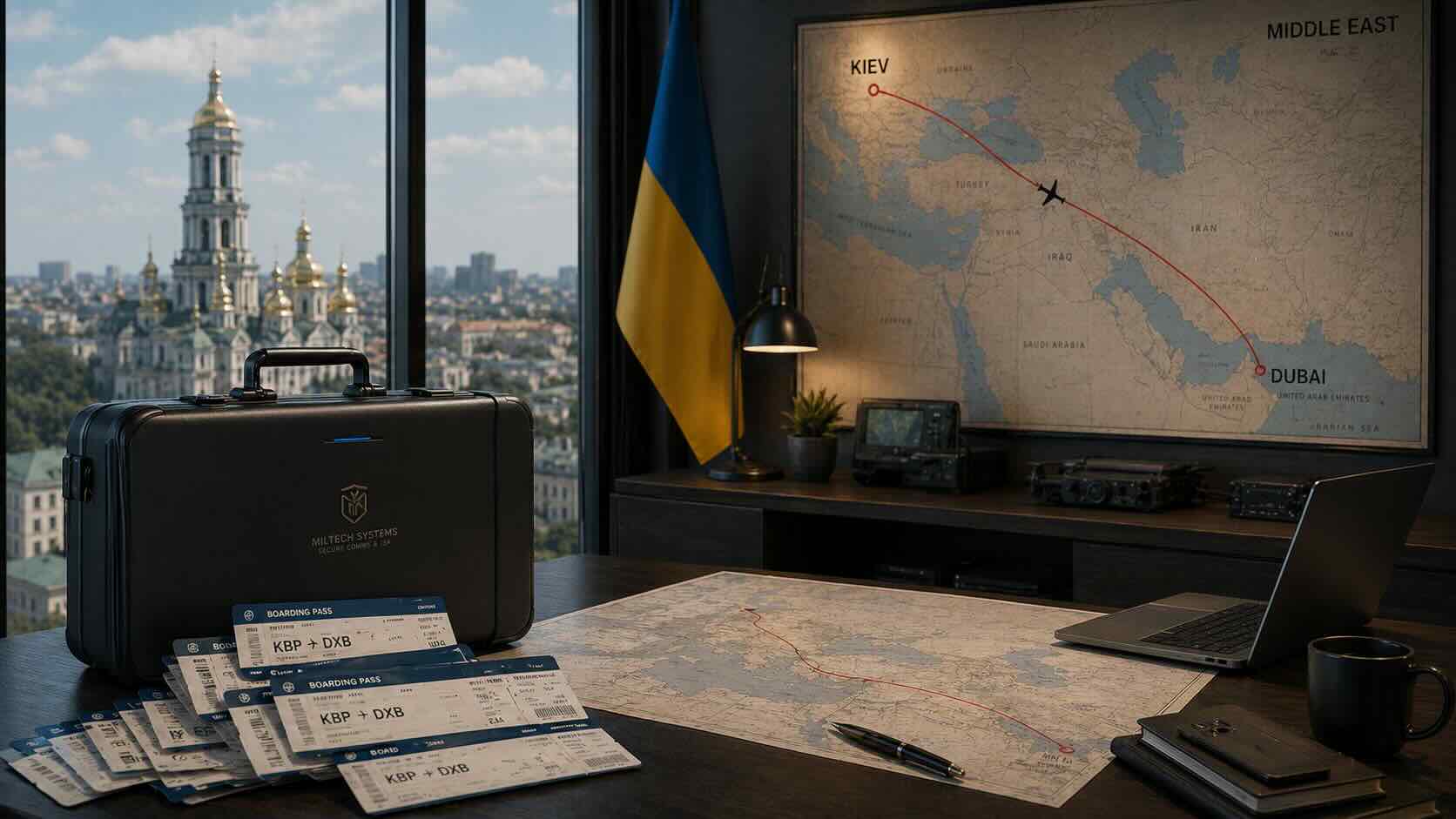
Following a series of deals with Gulf countries, Ukraine has signed new defence agreements in the Middle East. Is there reason to be suspicious that these defence pacts are, in fact, just another example of the Ukrainian elite’s typical practice of embezzlement?
Amid the U.S.-Israeli military operation against Iran, Ukrainian President Volodymyr Zelenskyy visited several Middle East countries and offered Ukraine’s expertize and technology on how to counter Iranian drones.
After defence agreements with the UAE, Qatar and Saudi Arabia, Ukraine has launched talks with Oman, Kuwait and Bahrain on security cooperation. Although Ukraine was also open for talks with the Israeli leadership, interestingly, no meeting took place between Ukrainian president Volodymyr Zelenskyy and Israeli PM Benjamin Netanyahu. Besides many more issues concerning Zelenskyy’s Middle East tour, we also will explain you why this meeting was skipped.
Let’s look into this issue in depth.
The answer to the question of why Ukraine was the solution for the countries in the Middle East in this particular situation, provides Ukraine’s defence ministry which says that Russia launched roughly 54,000 of the drones last year alone, many of them were Iranian-designed Shahed-136 drones. To counter the attacks, Ukraine has built what can be described as the most extensive anti-drone ecosystem in the world. Ukraine now deploys a wide range of interceptor drones. In February 2026 alone, more than 1,500 Shaheds were reportedly shot down by drones in Ukraine. It should be noted that the main factor behind Ukraine’s ’creativity’ was the cost factor: a Shahed drone costs roughly $30,000, but a Patriot PAC-3 interceptor missile costs millions of dollars. Ukrainian interceptor drones cost around $2,500.
As part of the security deals with the countries of the Middle East, Ukraine also has sent 200 drone experts to the Middle East. The Ukrainian president said that discussions on oil supplies – a key issue for a Ukraine at war with Russia – were also part of the talks.
Ukraine will receive much-needed fossil fuels from Gulf countries in exchange for the defense assistance it is providing, President Zelenskyy said. In an interview he mentioned Ukraine’s ongoing security dialogues with Saudi Arabia, the UAE, Qatar, Jordan, Turkey, Syria, Oman, Kuwait, and Bahrain, along with requests for cooperation from Iraq.
As one can immediately see, the list of new allies of Ukraine only includes Muslim countries. Perhaps this is why the Israeli leadership ultimately ignored Kyiv’s offer for consultations. ’Netanyahu has what I need and I have what he needs. So I’m ready for this dialogue,’ Zelenskyy said, but ultimately no meeting took place between him and his Israeli partner.
Looking at the list of officials in the Ukrainian delegation responsible for drone diplomacy, right after President Zelenskyy, media reports mention Rustem Umerov, Secretary of the National Security and Defense Council of Ukraine.
Umerov, a key person in Zelenskyy’s team with excellent U.S. ties, a Crimean Tatar – a Turkic group of Sunni Muslims – served as Ukraine’s defence minister between 2023 and 2025. He replaced Olexiy Reznikov as minister of defence who left this position amid corruption scandals in the military. Umerov also maintains good relations with Türkiye and many Arab countries.
When a criminal probe into the possible abuse of power by Umerov was launched in January 2025, it left quite a big stain on his honor. In addition, the Ukrainian Defence Ministry’s procurements were also examined by Ukrainian anti-corruption agency NABU. In the summer of 2025, Zelenskyy appointed him as secretary of the National Security and Defence Council as part of a government reshuffle which seemed what it was in reality: an escape for an old friend and loyal person who knows almost everything about ’government practices’.
Things got even more complicated when, in September 2025, the Ukrainian Anti-Corruption Action Center published a report stating that Umerov’s family owned eight luxury properties in the US.
In addition, according to Ukrainian prosecutors, Rustem Umerov was involved in a case to buy cheap Chinese bulletproof vests for inflated prices in another case investigated by NABU. The state did not pay for the vests after poor performance in military testing. Umerov has not been charged and said he is innocent of any wrongdoing.
Umerov was also mentioned in the most damaging corruption scandal of Volodymyr Zelenskyy’s presidency known as ’Mindichgate’. It was established by the Ukrainian authorities last year that some of Zelenskyy’s close associates were involved in a plot to skim around $100 million from Ukraine’s energy sector. Umerov who was also mentioned in the case documentation, in his response to the Ukrainian anti-corruption authorities admitted that met Timur Mindich, a close ally of Zelenskyy, to discuss a body armor contract, but denied any pressure and claimed that these discussions were later terminated. ’Any attempts to link my work at the ministry of defense with the ‘influence’ of certain individuals are unfounded,’ Umerov said.
It should be noted that, Rustem Umerov as defence minister launched the so-called Drone Line initiative, aimed at expanding the use of UAVs to create a continuous strike zone along the front line. Most European leaders supported this creative idea, claiming that Ukraine’s drone wall is in fact Europe’s first line of defense against Russia. If Ukraine’s drone wall can stand firm, it will likely be recognized as an essential element in Europe’s future defense against Russia, an analysis by The Atlantic Council says.
In light of these developments, there is good reason to refer to Zelenskyy’s visits to the Middle East – aimed at selling Ukrainian drone expertise and anti-drone technologies – as a second chance for Rustem Umerov to expand his ’game of drones’. At the same time, it is also worth repeating that Umerov’s name has frequently been mentioned in various corruption cases, which makes it reasonable to assume that the enormous sums agreed in the aforementioned defense pacts with Middle East countries can simply disappear into thin air. Although this time it is not European funds but Arab money that is involved, given Ukraine’s EU candidacy, it is still a matter of reputation for Europe.
’This is far more than simply receiving money.’, Volodymyr Zelenskyy said. Is that really the case? There is every reason to be sceptical.


