
When his government started to work in 2022, Slovenian Prime Minister Robert Golob promised a socially just and solidarity state based on knowledge, where ‘everyone would take their fair share of the burden from rising food and energy prices’.
The grandiose visions included a carbon-free society supported by nuclear technology. But the focus was supposed to be on helping vulnerable households and farmers.
Later on, as the housing crisis deepened, affordable housing also entered the prime minister’s list of priorities – in 2025, barely a few months before the end of the government’s mandate.
The promise this time was to ‘set an example in Europe of how to tackle housing issues’ – and the delay in addressing the problem was justified by ‘the holistic view of the whole issue’ and the plan to ‘tackle this long-term issue in an appropriate and coordinated manner’.
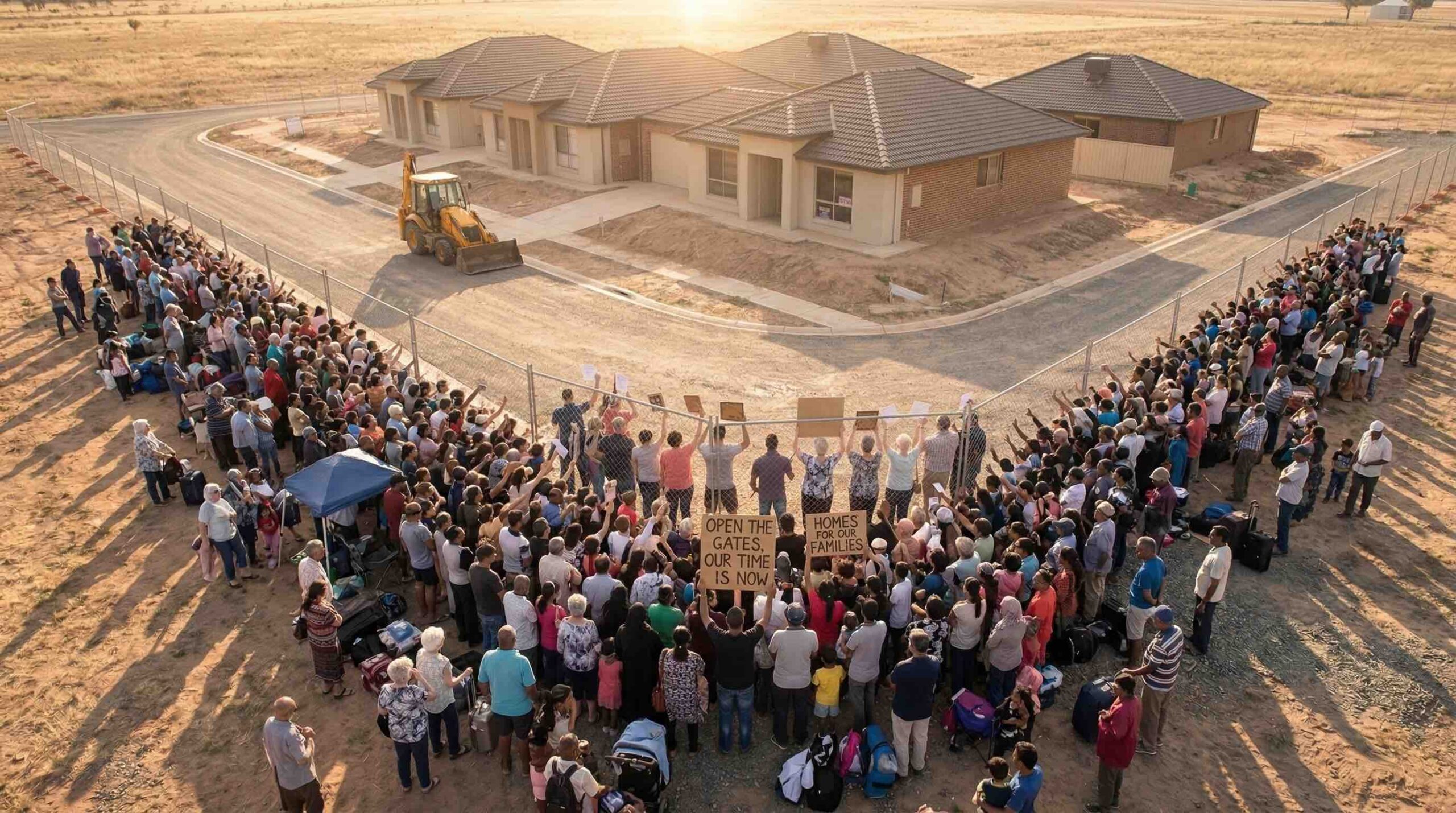
The reality is that Slovenia faces a dire shortage of affordable housing.
A 2024 OECD report states that Slovenia’s current housing challenges are ‘characterised by strong demand and inadequate supply, exacerbated by rising construction and financing costs’. Rental markets are limited, residential construction activity is insufficient.
Golob’s government promised €100 million annually over the next decade, to build 20,000 new public rental homes – theoretically a huge raise to the €15 million that was earmarked for the same task between 2015 and 2022. A raise in state subsidies for the most vulnerable tenants was also announced.
Unfortunately, the measures not only come late, but are also misguided: the lack of available housing is the result of the interplay of complex causes. Experts have warned that it is unlikely to be solved by this type of government intervention.
The biggest culprit is the bureaucratic labyrinth of obtaining a construction permit. The costly process can take years. The results of which show clearly: in 2023, only 797 new apartments were built in the capital city Ljubljana.
The real profiteer is the state: taxation and fees contribute to almost 15 percent of the cost of a new apartment.
Yet, the government thought more taxation was a good idea to increase state revenues. In 2025, the cabinet proposed an annual levy of 1.45 percent on second (third, etc.). It was also thought to help with housing shortage – as it would have affected about 525,000 properties.
Following widespread criticism from experts and public outcry, the government eventually postponed the tax that was more a plan to create elaborate tax avoidance schemes and possibilities for the elite to exempt their luxury ‘first homes’ than a real solution to the housing crisis.
When it comes to affordable housing units built by the state, the results are dismal: a Court of Audit report found that only 32.5 percent of the planned units was built.
Ineffective regulation, roadblocks and state hypocrisy mean that both sale and rental prices are increasing.
While the average Slovenian finds it harder and harder to secure decent housing – Golob’s innermost circles profited handsomely about their connections.
As Slovenian media widely reported in 2022, Golob’s former colleague at Elektro Ljubljana, Chairman of the Management Board Andrej Ribič colluded with Bojan Kumer, CEO of the company Elektro Energija in the sale of a 60 sq m apartment in Ljubljana. The apartment in question belonged to Elektro Ljubljana and was sold way below market price.
And that’s just one of the many.
Instead of solving the housing crisis, the Golob government is creating more problems and bottlenecks with introducing more regulations and lofty plans. The only beneficiary will be the prime minister and his closest circle, while ordinary Slovens will not able to afford even a modest lodging.


