
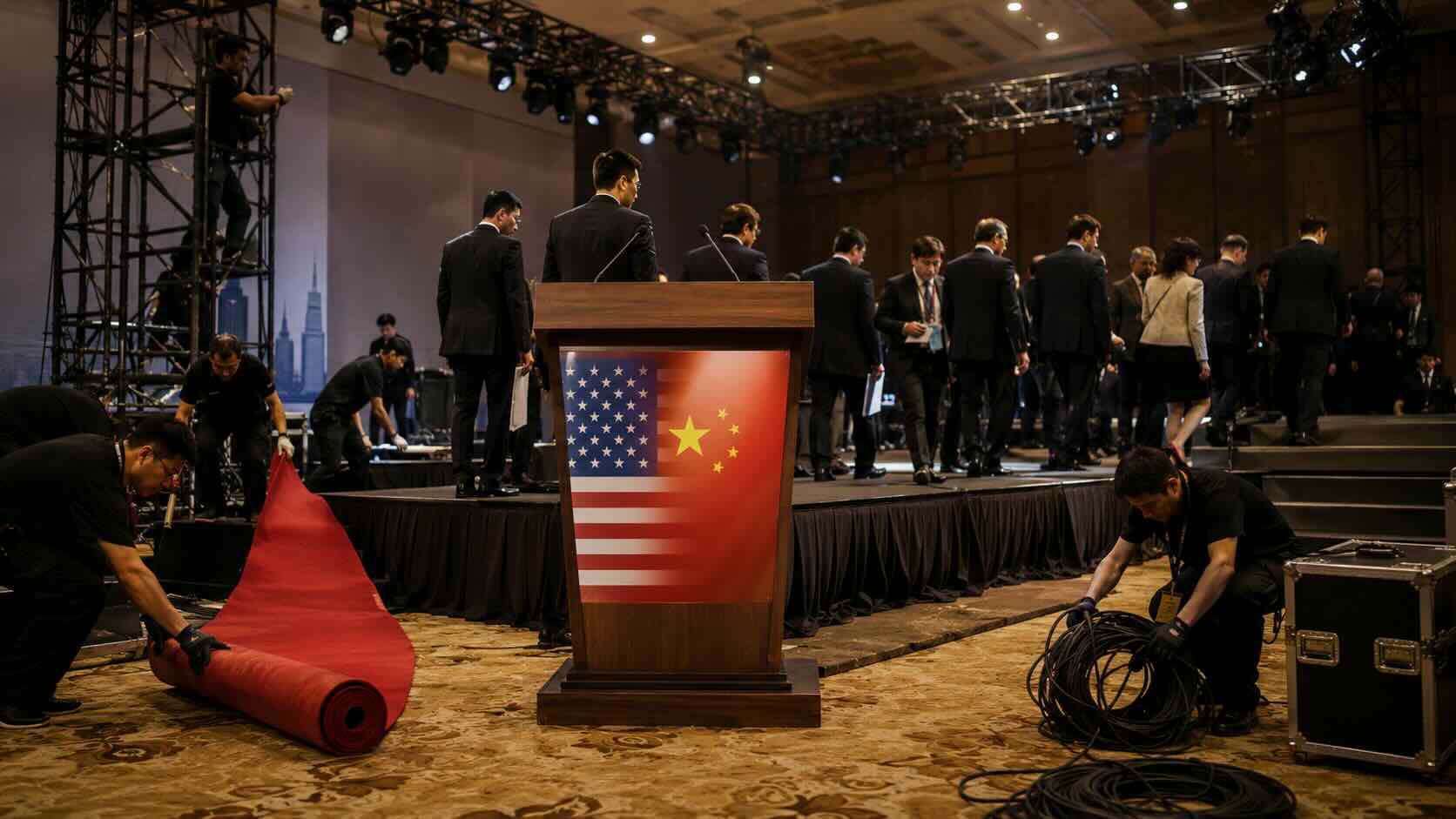
The long-awaited summit between President Trump and President Xi was sold to the public (as usual) with the kind of cautious optimism that appears only when both sides know they are both carrying heavy bags. And this time we are talking about the two geopolitical heavyweights of our era.
The official mood has been “constructive”.
The flexible diplomatic phrase that usually translates to, ‘nobody is expecting a breakthrough, but everyone wants to leave with enough dignity to brief the press as if one almost happened’.
Of course, with enough problems to fill several books, no grand reset was even remotely likely.
Trade, tariffs, rare earth exports, advanced semiconductor restrictions, Taiwan, artificial intelligence, and China’s role regarding Iran and the Strait of Hormuz were all on the table. The Americans were emphasizing the “B”-s (Boeing, beef, (soy)beans, board of investment, board of trade). The Chinese focused on the “T”-s (tariffs, technology and Taiwan).
Too many conflicts of interest, with only few overlaps.
No lavish welcome ceremony, handshake or photo-session can undo that, even if both leaders prepared meticulously and had experts with them enough to fill AirForce One to the brim. (Though Trump opted to take businessmen instead
Even the White House, usually boastful and all bravado, opted for realism disguised as optimism and appeared to be looking for incremental progress rather than a grand deal – except for the occasional posts from President Trump, pointing at his friendship with his Chinese counterpart.
On the upside, Trump became the first American president to visit China in almost a decade (following his own footsteps on his 2017 visit). They did meet before though, in South Korea in 2025, establishing a shaky truce and paving the way to this visit.
The visit was still a step forward – even if mostly in the form of a carefully staged exercise in damage control.
President Trump didn’t plan it this way.
When Trump rescheduled the summit in March, it was hoped that the Iran conflict would be already over. A show of force to prove that the US still had the upper hand, even if China has quietly established authority in corners of the world politics previously dominated by Washington.
President Xi has his own problems, of course – ranging from slower economic growth at home to the global energy crisis threatening with recession.
The elephant in the room (amidst the myriads of issues) was of course, Iran.
It’s not without irony that Washington wants (and needs) China’s help on Iran.
This, naturally, is where American strategy acquires its most elegant quality of all—trying to pressure China while also asking it to solve a crisis the U.S. itself has helped intensify. Even if Beijing also needs the problem solved as soon as possible given it’s dependence on Middle Eastern fossil fuels.
President Xi did what he is (and all Chinese diplomats) are best in: he listened and responded in the usual way (adding a few warnings on Taiwan for good measure). A calm face and a polite refusal with some concessions, while extracting some concessions from Trump in exchange – perfectly aware that the embattled American president needed to claim the trip as a win.
Unlike Trump, who’s facing midterm elections and the blessings and curses of public scrutiny, China can wait and keep its distance.
With this background, the summit delivered exactly what was expected from it and not much more.
A controlled performance of mutual restraint, a few documents and a promise to keep talking.


