
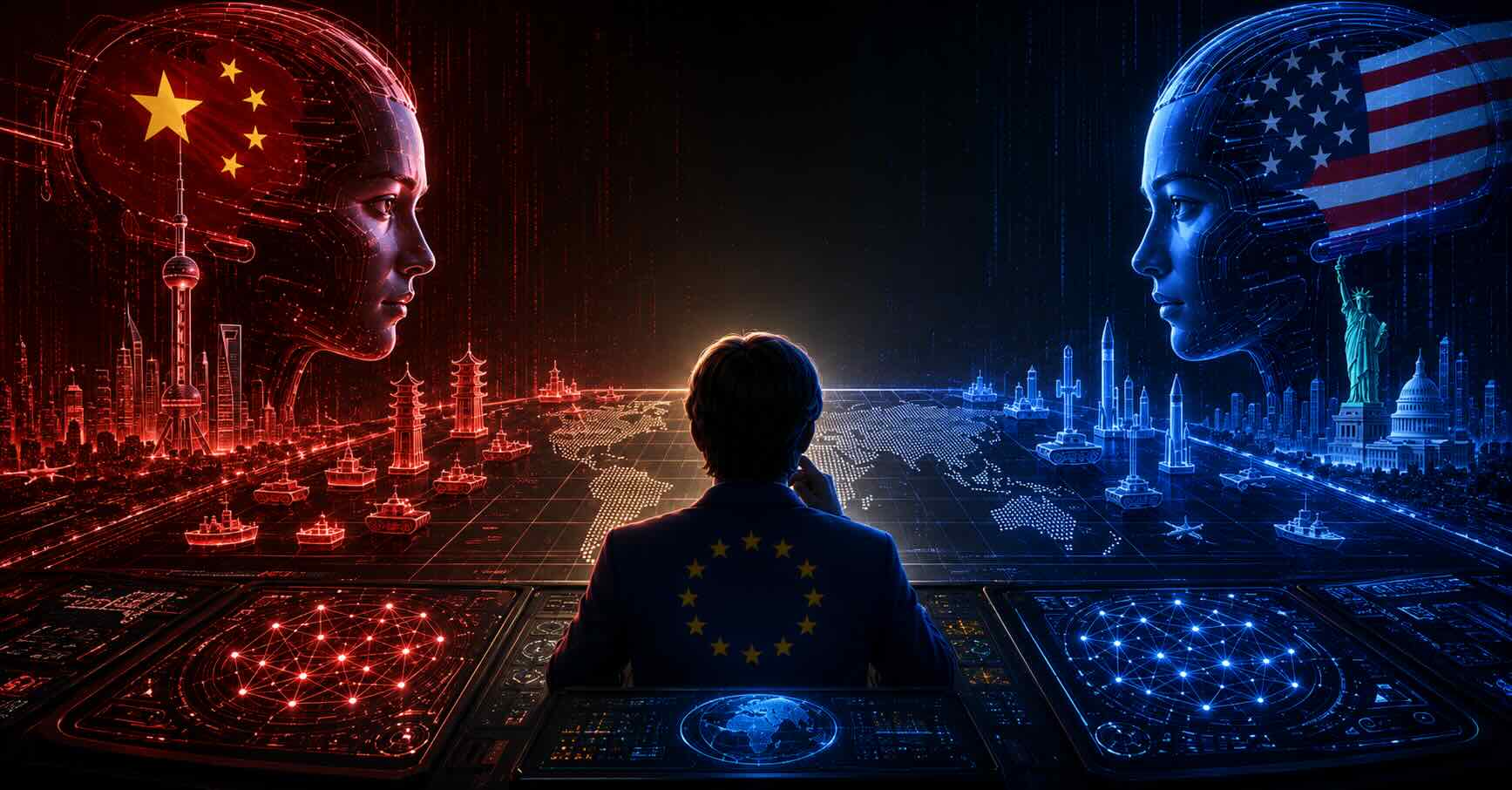
It was easy to dismiss President Xi’s speech at the World Artificial Intelligence Conference on 17 July as another carefully crafted statement about international cooperation. In reality, it was a declaration of competition with the US. On a field where both countries invested immense energy and resources recently.
In his speech, the Chinese President invited the rest of the world to work together in the new AI revolution, thereby sending a powerful message to the US: China might have the solution to neutralize American efforts to maintain technological dominance.
President Xi spoke of a “people-centered” approach to artificial intelligence, open-source collaboration, common security, human oversight and a “just and equitable” global AI governance system. He argued that no single country should dominate AI and criticized the overuse of national-security arguments to control advanced semiconductors and AI technologies.
But the significance of the speech lies less in its rhetoric than in its strategic logic.
For decades, the United States was the only real power that developed – and used with extreme proficiency – a wide range of soft-power tools to influence the world. Hollywood, NGOs, Silicon Valley, the dollar, elite universities, consumer brands and democratic ideals together created an ecosystem that attracted countries not merely to American products but to the American-led international order.
In the last decade or so, the world understood the functioning of soft power and learned to use it. Some (think: China) started copying this toolkit or simply countered the US efforts. In a bit of oversimplification, this trend led to the Trump administration’s decision to demolish the traditional soft power system of America, as it lost a great deal of its influence, or, in cases it became damaging.
Technology was the last of Washington’s soft power/geopolitical assets.
Mainly because others wanted to build on American platforms, while others were unable to match the United States at the very frontier of semiconductor manufacturing, innovation. Thus, driven by the belief that it can dictate to the industry, Washington had a strong incentive to start the electric mobility.
China had different plans.
The latest battlefield is the AI. It started to “spread its wings” in the US. During the last year American investors poured enormous amounts into the field to support this revolution and to develop the world’s finest AI technology.
July 17 became the day when China unveiled its strategy to counter America’s own AI dreams.
And Beijing embraces a different approach: rather than winning through exclusivity, it aims to win through accessibility.
Chinese AI companies release powerful open-source models at little or no cost. President Xi didn’t hide it under the rug that his model was not simply technological competition but as an alternative model of global development. Chinese officials promised greater cooperation with Africa, Latin America, Asia and BRICS partners to expand AI capabilities and prevent what Xi described as “new historical injustices” in access to artificial intelligence.
This is much more than a simple industrial strategy.
If developers across emerging markets build applications on Chinese-origin models, many will naturally adopt Chinese cloud services, development tools, technical standards and perhaps eventually Chinese hardware. Once ecosystems form, they become remarkably durable. Software developers rarely change platforms without strong incentives.
China doesn’t promise the best AI model, it offers only a good and cheap solution. A stark contrast to the U.S. strategy aiming to create the best, but (at least at the beginning) expensive solutions.
In other words, China is attempting to shape the foundations of tomorrow’s AI economy rather than merely competing for today’s model rankings.
Ironically, Washington may have helped to accelerate this shift.
U.S. export controls on advanced chips were designed to slow China’s progress toward frontier AI. Instead, they have created powerful incentives for Chinese researchers to build models that achieve competitive performance using fewer computational resources. Efficiency has become a necessity rather than a choice.
Meanwhile, American AI companies face growing pressure from investors asking a difficult question: where will the profits come from? Investments in chips, data centers and models eventually must generate sustainable returns. If not the best, but still capable open-source alternatives continue improving — and especially if they are freely available — that can create uncertainty about the sustainability of the American strategy.
The concern is not simply about today’s market volatility or temporary declines in technology stocks (which happened just recently). It is about a long-term strategic question whether developed AI platforms can maintain pricing power in a world where increasingly capable alternatives are available to everyone. Or how the profit calculations will work if two-thirds of the world has a cheaper open-source alternative.
Stanford researchers have already noted that widespread adoption of Chinese open-source models could reshape patterns of technological dependence and influence. The strategic value lies less in the models themselves than in the ecosystems they create.
A new world leadership plan, disguised as AI strategy.
Traditional soft power encouraged others to admire your culture or political system. Digital soft power encourages others to build their economies on your technological infrastructure. The latter may ultimately prove more durable because switching technological ecosystems is significantly harder than changing political sympathies.
The irony is striking.
Precisely in the moment when the United States is placing greater emphasis on technological containment and national security, China is presenting itself as the champion of openness, affordability and broader access.
Whether Beijing fully lives up to that narrative is another matter. The messaging itself is strategically effective.
That leaves Europe facing perhaps its most consequential digital choice in decades.
The European Union has invested enormous political capital in becoming the world’s leading AI regulator, as the EU realized soon that is incapable to compete with the US tech sector. Through the AI Act and broader digital legislation, Brussels hopes to shape global norms even if it cannot dominate the frontier of AI development itself.
But regulation alone will not answer the harder geopolitical question.
Should Europe align fully with Washington’s strategy of technological restrictions and strategic decoupling and open its wallet to pay for the pricey American services? Or should it take advantage of lower-cost Chinese AI models where security risks appear manageable? Or should it attempt the increasingly difficult balancing act of preserving transatlantic security ties while maintaining enough openness to remain globally competitive?
None of these options comes without costs.
Europe therefore faces a dilemma that cannot be solved through regulation alone. It requires an industrial strategy capable of supporting European AI capabilities while preserving strategic autonomy between two increasingly competing technological superpowers.
The only thing certain is that China has already changed the terms of competition. AI is no longer simply a race to build the most powerful model. It is increasingly a contest over whose ecosystem becomes the world’s default infrastructure.
The question is what if the EU continues the work the way that China started and spread across the world with its own open-source models?


