
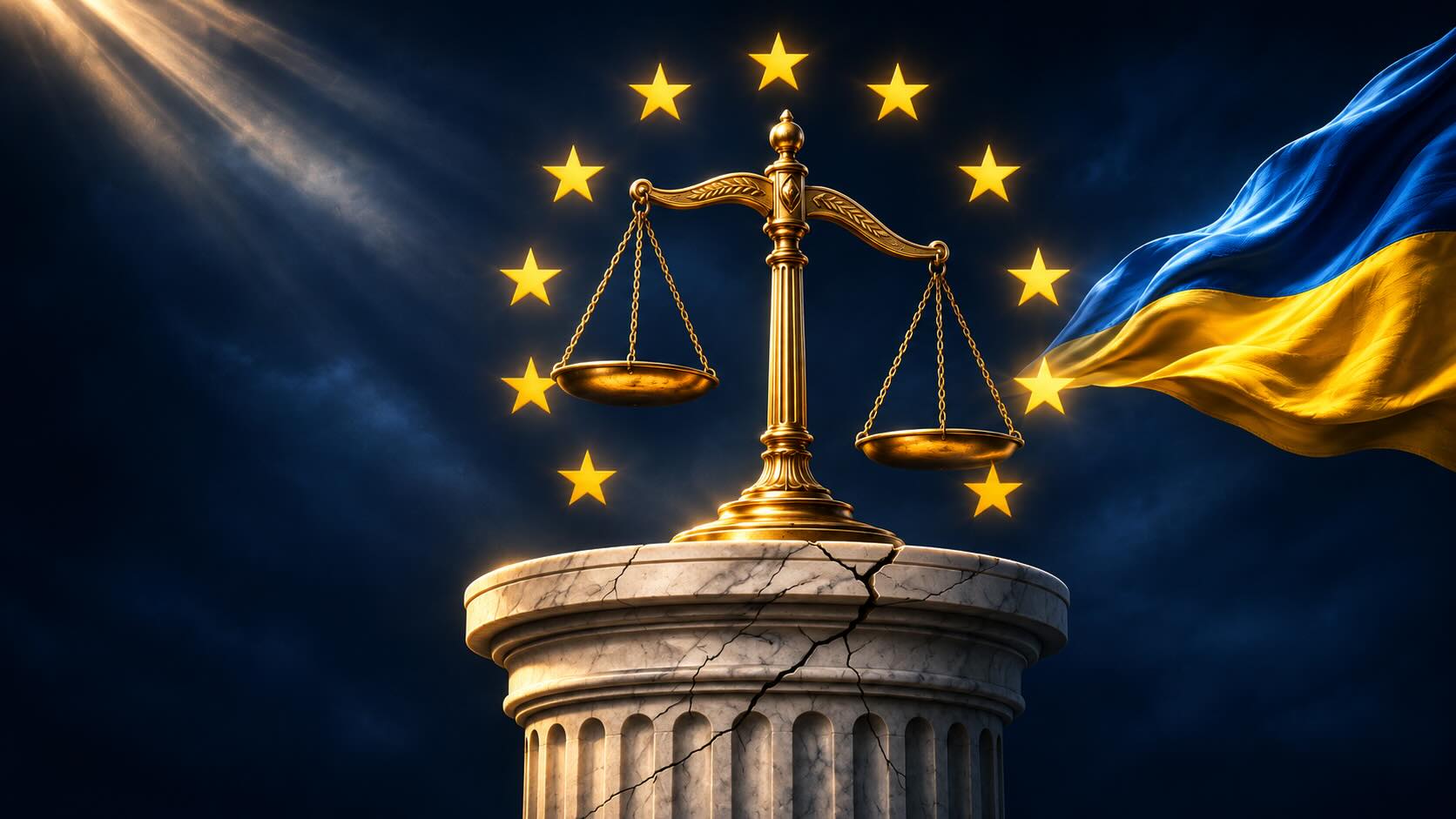
Since the EU accession process requires Ukraine to transform its governance system in order to fully comply with the Copenhagen criteria – which, on the first place, says a candidate country must show full respect for the rule of law and stable democratic institutions ensuring the protection of fundamental values -, it is worth taking a closer look at the preparadness of the country ravaged by war.
’Fantastic news – all EU member states have given the green light to open Cluster 1 in accession talks with Ukraine and Moldova,’ Ukrainian Prime Minister Yulia Svyrydenko wrote this summer. ’We are one step closer to EU membership: steadily moving towards our goal.’ (NB: A month later, PM Svyrydenko, for unknown reasons, submitted her resignation and stepped down. Her departure coincided with a major corruption scandal in the top circles of the Ukrainian political and economic elites.)
The issue of the rule of law has always been crucial in the EU accession process. The cluster of negotiation chapters titled ’Fundamentals’ which deals with the rule of law is the first to be opened (’Cluster 1’) and is not closed until the negotiation process has been completed.
Although Ukraine’s specialised anti-corruption institutions such as the SAPO and NABU play an important role in combating corruption, the country’s governance model does not yet meet the requirements of the rule of law, allowing corruption to remain entrenched, according to a study by the German Institute for International and Security Affairs (SWP). The SWP adds that Ukraine’s oligarchic model of governance is not a thing of the past in Ukraine, however, the country has embarked on a path towards greater rule of law.
When assessing the rule of law situation in Ukraine it is necessary to point out that, President Volodymyr Zelenskyy, just like his predecessors, has sought to expand his power and take control of parts of the judiciary. Moreover, he repeatedly neglects the core function of the parliament as a source of checks and balances. In the case of a president, whose mandate expired in 2024, this is indeed remarkable.
Another deeply-rooted problem concerning the approach to the rule of law approach in Ukraine is that anti-corruption institutions operate in a parallel track within a largely unreformed justice system. In addition, as a result of the full-scale war with Russia, power has been totally centralised in the Office of the President (OP).
It is worth citing BTI country report 2026 which says: ’Accession talks [with Ukraine] are underway, focusing on legislative and institutional reforms to align with EU standards in the rule of law, human rights and anti-corruption. (…) The order of checks and balances has not been changed by martial law. Though the president has gained some additional powers, parliament is still the only legislative body and judicial control is still active’. At the same time, the report notes that the OP has a unique position in the system of state institutions. ’In reaction to Russia’s full-scale invasion in 2022, power was further concentrated in the OP. This led to a further weakening of the parliament’, according to the report.
Studies by political research institutes on the situation in Ukraine point out that the power struggle between the president and the government or the parliament is reflected in the changing competences attributed to those institutions under the various versions of the Ukrainian Constitution. In fact, experts stress, successive presidents have sought not only to control the government and parliament either directly or indirectly; they have also attempted to extend their influence to a range of other institutions, such as the Prosecutor General’s Office or the Constitutional Court.
Given the contradictory situation regarding the rule of law in candidate country Ukraine – a situation further complicated by the fact that the country is currently at war, with a fifth of its territory under enemy occupation -, there is a question as to whether the standards of EU democracy and rule of law are more important to the Union and its Member States than the political decision to admit Ukraine into the bloc, despite the country’s poor preparedness.
Anyone who truly believes in the EU’s core values can only conclude that, given Ukraine’s current insufficient preparedness, the country’s accession would, in fact, undermine the EU’s overall good performance in terms of the anti-corruption efforts and the rule of law, which could lead to growing tensions within the European family. Furthermore, it is worth noting that such a deterioration in the rule of law could weaken the EU’s strong position at the forefront of global efforts to promote the Union’s core values.


