
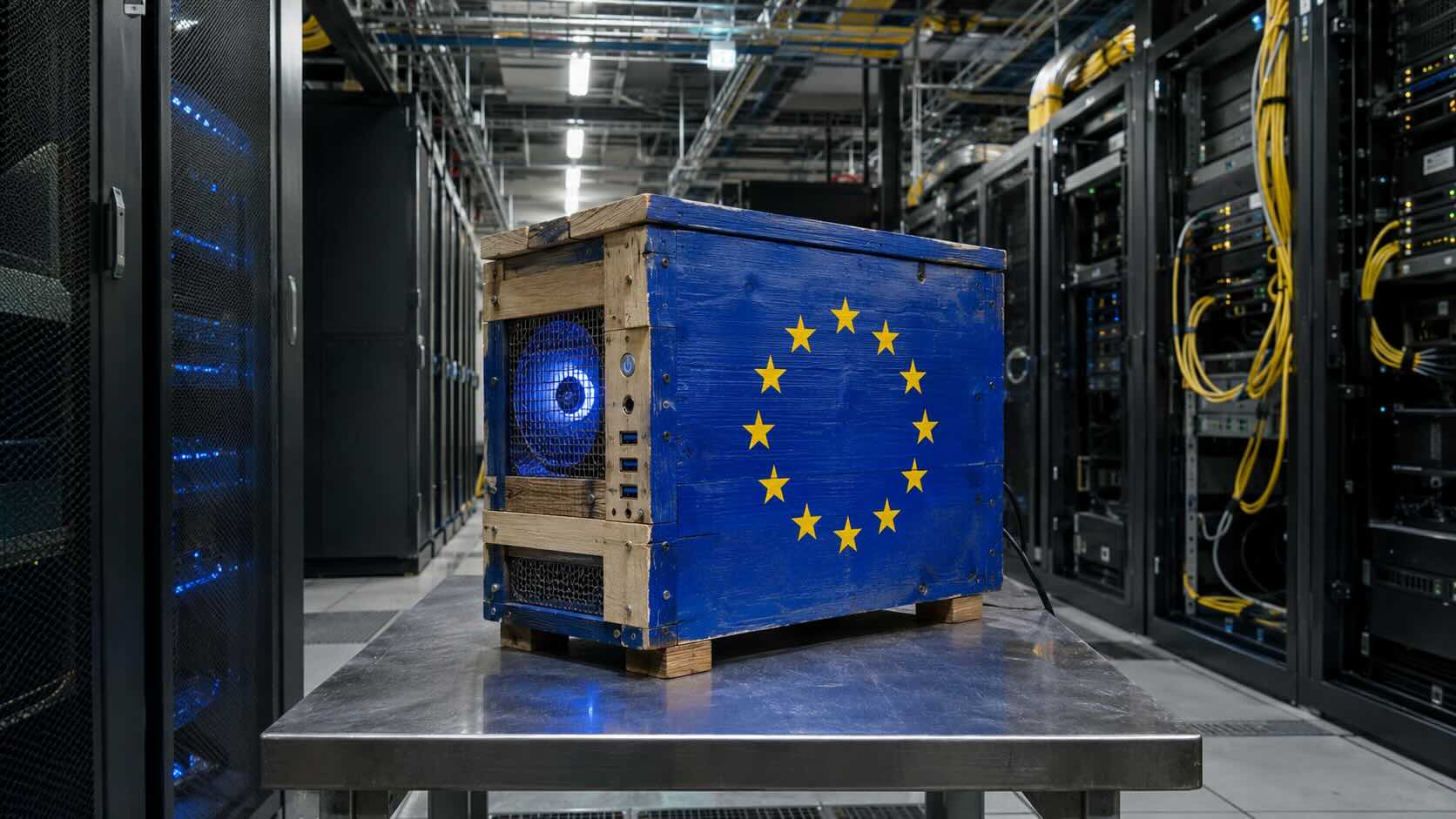
With a bit of delay, the European Union has launched an aggressive strategy to catch up with the US and China in the global AI race.
The idea is to finance massive data centres dubbed “AI gigafactories”.
A step long overdue, as the EU is far behind in this race which has been so far fought mainly by the other two major centres. Both—well, mainly the U.S.— have already amassed massive capacities and invested huge amounts in the AI competition. Due to restrictions on the trade of advanced chips, China chose a more compute-efficient way to compete with the States and, with its open-weight platforms, offers cheaper accessibility. The U.S. prime position is undisputable in the most advanced AI models, but the Chinese strategy, with its different approach, also achieved commendable results.
Thus, the current AI computing capacity in the world is distributed quite unevenly: the U.S. has 35 GW, China 5 GW, and the EU 2 GW.
In mid-2026, the European Commission issued a call for tenders aimed at pooling over €30 billion in state and private funding to construct seven high-performance AI data hubs, to be managed by the European High Performance Computing Joint Undertaking (EuroHPC JU).
The European Union’s sovereign AI infrastructure strategy is split into two distinct tiers under the EuroHPC JU: 19 mid-scale “AI Factories” (focused on upgrading existing supercomputers) and the newly launched 7 high-scale “AI Gigafactories” (the €30 billion massive-scale projects).
The initial 7 AI Factory hubs—which are laying the groundwork for the larger upcoming gigafactory tender selections slated for early 2027—will be spread across seven host nations: Finland (utilising facilities like Kajaani), Germany (leveraging sites like the JUPITER exascale system), Italy (focused near major technical hubs), Spain (Barcelona Supercomputing Centre), Greece (Athens), Luxembourg, and Sweden.
Eighteen EU member states have signed a joint procurement treaty to host or financially back these distributed, cross-border compute facilities.
The European AI Gigafactory Initiative aims to reduce the continent’s reliance on American technology giants for computing needs. It does so with a very ambitious time frame, with the newly built infrastructure expected to be ready by the end of 2030. These gigafactories are designed to host supercomputers built with up to 100,000 advanced AI processors. There are some European enterprises, such as Germany’s SAP and Deutsche Telekom, ready to back one of these major data centres, but there are some unanswered questions, too.
While the initiative is undoubtedly necessary, there are some structural weaknesses that, in the long term, can generate greater dependence for the EU, with exactly the opposite result than what the main aim is.
The successful implementation of this strategy – that is, implementing it in a way that strengthens European sovereignty – means that the EU must find a solution to two crucial questions. The first is the question of processor development and manufacturing. The second has effects that reach far beyond the global AI race: finding the natural resources (namely energy and water sources) to run the AI gigafactories.
As regards the first, the Commission is well aware that the EU has no chance to build more capacity than the U.S., thus it focuses on trying to win a hardware arms race instead. The European Commission has already signed letters of intent with dominant US chipmakers—including NVIDIA, AMD, and Qualcomm—to guarantee a priority supply of advanced AI processors. The goal is not to have the most data centres, but to ensure European researchers have unthrottled, highly secure access to cutting-edge silicon to build compliant, ethical “Sovereign AI” models. This means that the EU is asking these giants — over which no European country has any control at all —to provide advanced chips. And in theory, each of those companies have agreed that, yes, they will.
In a world where advanced chip trade is one of the most crucial tools for punishing or rewarding rivals and allies, this advance trust feels much like a leap of faith. A silent Hail Mary hoping to buy the most advanced technology to get on the fast track in this industrial race. But as the last few years have shown, there are no guarantees that these companies will be ready, will be able, or will be allowed to export their most advanced models to the EU when there is a huge global struggle for these ‘resources’.
Alas, this is only the first point of weakness in the imperfect project that risks spending a fortune and guarantees only questionable results.
The energy and water issue has even more pitfalls.
Following the severe, record-breaking dry periods that crippled agriculture and river systems across Europe this year, water depletion has shifted from a long-term climate goal to an urgent battle. Even in the U.S., there were (are) massive protests against new data centres, because they use large amounts of fresh water for cooling (thus evaporating the already scarce resources) and their energy demand makes local energy prices surge.
To address these questions, the European Commission introduced a sweeping new regulatory framework targeting all data centres with a capacity of over 500 kW. One part of the package is the introduction of Power Usage Effectiveness (PUE). To secure an “A” rating, facilities must hit a PUE of ≤ 1.15 (meaning no more than 15 percent of total energy can be lost on infrastructure like cooling). Another metric is Water Usage Effectiveness (WUE). To receive a top rating, data centres must keep water consumption at or below 0.10 litres per kilowatt-hour (l/kWh) of IT power used.
Of course, massive server sites risk overwhelming existing continental power supplies. Thus, the plan prompted calls for urgent grid modernization and the creation of new production capacities.
Only if certain European countries wouldn’t have a strange aversion to nuclear energy, right?
Because without going nuclear (again), the question still stands: how will the EU handle this new energy requirement especially with growing energy import costs and bottlenecks?
Theoretically, the EU requires climate-neutral operations for regional AI services, forcing data centres to secure massive amounts of renewable energy and requiring a shift in cooling technology. Sounds great and can be a real solution.
But building eco-friendly data centres is only the first step. Europe must also provide a reliable, affordable, and increasingly carbon-free electricity supply, potentially requiring another enormous investment in energy infrastructure. One that will ensure that the skyrocketing demand doesn’t affect European energy prices.
To put in perspective: according to the estimates in the available analyses, an individual AI Gigafactory could require between 300 MW and 1 GW of electrical capacity, depending on its final size. A 1 GW facility operating continuously would consume approximately 8.76 TWh of electricity annually. The same analysis projects that total European data-centre electricity demand could rise from approximately 12 GW to 28 GW by 2030.
To meet this demand would mean that powering a single 1 GW AI cluster with dedicated renewable generation, battery storage, and grid upgrades could easily require an additional 10–20 billion EUR (or more) in investments. That’s actually more expensive than to build a data centre.
Wind and solar power are essential to Europe’s energy strategy, with occasional addition of hydro power. Unfortunately, neither guarantees continuous electricity production.
This means that datacentres run by renewable energy sources might need 3- or 4-times higher built capacity as the planned consumption and even this oversized renewable generation would not, by itself, guarantee uninterrupted supply.
A dependable system would also need sufficient storage, electricity imports, or other dispatchable capacity. For example, nuclear energy.
As the latter is not an option in this moment (neither does it seem feasible to built nuclear powerplants within the next 3 or 4 years), the only real option is to rely on gas-fired power plants, as it happened in the U.S. where AI datacentres have their own gas power plants.
The U.S. has it easy, though.
To illustrate the potential scale: supplying a continuous 28 GW electrical load entirely from modern combined-cycle gas plants operating at 55% efficiency would require approximately 42.5 billion cubic metres of natural gas annually. At 40% efficiency, consumption would rise to approximately 58.4 billion cubic metres. The scenario is hypothetical – but the volume is not. And 42,5 billion cubic meter is around Italy’s yearly gas consumption.
On a continent that is heavily reliant on imported natural gas – gas power plants would expose the EU to international price fluctuations, geopolitical risks, and competition with other major gas consumers, and would also create tension between the ambition to develop sovereign AI infrastructure and the continued dependence on external energy suppliers. Other unintended side-effects might include the further loss of competitiveness in other industrial sectors (due to higher costs) and increased burden on the households. It’s up to the EU and the Member States to find the most optimal solution – one that doesn’t cause more damage to the continent than the (humiliating?) third place in the global AI race


