
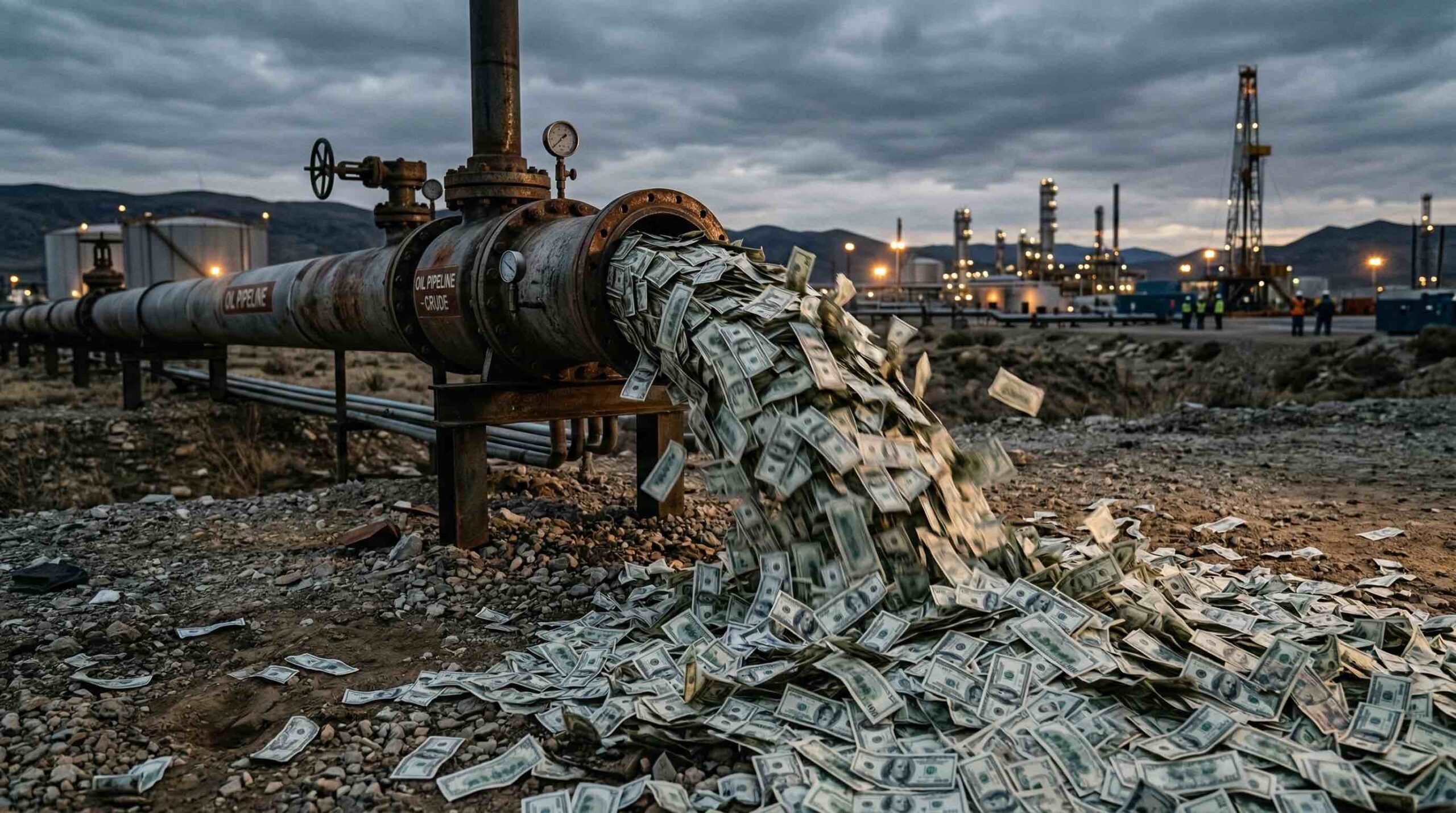
With the European Union’s overall financial support to Ukraine reaching €194.9bn (with an additional €90bn loan on the horizon) and, an estimated €500bn post-war reconstruction cost, it is worth taking a behind-the-scenes look at Ukraine’s corruption map, with a focus on the country’s energy sector.
Ukrainian anti-corruption investigative agencies such as the National Anti-Corruption Bureau of Ukraine (NABU) and the Specialized Anti-Corruption Prosecutor’s Office (SAPO) have made great efforts in recent years to reduce the level of corruption in Ukraine. In this nearly hopeless fight against corruption, publicity has been the most effective tool.
Ukrainian anti-corruption bodies have launched several investigations in recent years to uncover corrupt practices in the Ukrainian energy sector. Most of the investigations that have been successfully completed and sent to court cover the period between 2014 and 2016, while investigations into the more recent period are still ongoing.
The latest large-scale corruption scandal (codename Midas or, Mindichgate as many call it in Ukraine after the long-time business partner of President Zelenskyy, Timur Mindich who was ringleader in the criminal scheme) which resulted in the resignation of Zelenskyy’s close friend and political ally Andriy Yermak as Head of the President’s Office and detention of two ministers last November, is only the tip of the iceberg. Nothing but the surface even though in this scheme, at least $100 million was stolen over the last 15 months from the state nuclear power company through kickbacks to contractors, according to NABU.
Despite not only Ukraine’s Energy Minister Svitlana Hrynchuk and Justice Minister Herman Halushchenko, but also a former deputy prime minister, Oleksiy Chernyshov, and even Zelenskyy’s closest aid Andriy Yermak have proved to be an integral part of the scheme, this is unlikely the entire corruption network that can be observed across Ukraine, from state administration to corporate management. It should be noted that, in addition to the abovementioned top officials, other government figures such as former Defence Minister (current Secretary of the National Security and Defence Committee) Rustem Umerov have also appeared in the case.
With this material, we want to show what is hidden beneath the surface because that is where everything begins. That is where the raw strength that rules Ukraine comes from, something that even the Ukrainian president himself could not resist.
The corruption scheme in Ukraine’s energy sector is rooted in the system of the so-called oblegenergos, which means state energy enterprises at regional level. Among the investigations conducted and completed by the NABU at this level, it is worth mentioning the case of the oblenergos in Cherkassy and Zaporizhzhia regions, as they proved to be part of a wider corruption network involving, in addition to the above, the oblenergos in Kirovohrad, Sumy, and Ternopil regions, as well as other companies.
Back in 2021, ex-MP and former chairman of the board of the company Energoset Dmytro Kryuchkov and, the former acting chair of the board of Cherkassyoblenergo Svitlana Kuzminskaya were charged with emblezzement and legalization of funds of the state energy companies Cherkassyoblenergo and Zaporizhzhiaoblenergo, as well as abuse of office. The investigation found that the scheme organized by Kryuchkov caused more than UAH 1.5 billion of damage to the state. Instead of the state budget, the money ended up in private structures controlled by Kryuchkov.
In early 2025, Kryuchkov who fled Ukraine in 2024, was sentenced in absentia to 15 years of prison with confiscation of all property, after he was found guilty of embezzlement for UAH 1.5 billion. A similar verdict was received by Svetlana Kuzminskaya who was sentenced to 8 years of prison with confiscation of half of the property.
NABU first put Kryuchkov on a wanted list in 2016. Regarding him, it is important to note that, in addition to his other positions, he was also the chairman of the board of PJSC Energomerezha and, more importantly, was known to be closely associated with Ukrainian businessman Hrihoriy Surkis.
As mentioned above, the investigation into regional state energy companies found that they were part of a larger corruption scheme. This extensive network operates under the control of Ukrainian oligarchs Hrihoriy and Ihor Surkis, who, through numerous channels, have full control over the entire Ukrainian energy infrastructure, even though their involvement is typically only mentioned within the state-owned energy companies in Zaporizhzhia and Lviv Regions.
However, it should be noted that in 2016, Ternopil Oblenergo signed an agreement with UkrenergoConsulting LLC, a company linked to Ihor Surkis, to provide consulting services for UAH 2.3 million. It is also important to note that, under the terms of the agreement, the firm also advised oblenergos on legal issues, represent them in courts, in the Wholesale Electricity Market Council, ministries and the Cabinet of Ministers. The company’s director, Olexander Sagura, was also the chairman of the supervisory board at Prykarpattyaoblenergo which was controlled by Ihor Surkis.
According to data from investigative journalism reports, the Surkis family typically launders embezzled money through sports, including FC Dynamo Kyiv, using offshore companies and cryptocurrencies, before investing it in real estate, mostly in Monaco, Spain, and the UK. It should not be forgotten that Hrihoriy Surkis became President of FC Dynamo Kyiv in 1993 and has been UEFA Vice-President since 2013. In addition, he held different positions at the National Olympic Committee of Ukraine.
It appears that in the ’golden age’ of the criminal scheme, political protection for the corruption network outlined above was provided by Serhiy Shefir, an advisor to President Zelenskyy and founder of the Studio Kvartal 95, a company, which is associated with Zelenskyy’s early years, while law enforcement protection was provided by Ivan Bakanov, director of the Security Service of Ukraine (SBU), a close friend of President Zelenskyy, who was also a member of the Kvartal 95 team. (Bakanov was dismissed from his position as director of the SBU by Zelenskyy in 2022.)
An example of early ties is that in 2019, the year Volodymyr Zelensky became president, the then head of the SBU Ivan Bakanov and presidential aid Serhiy Shefir attented the celebration of the 70th birthday of Hrihoriy Surkis. In addition, in 2025, President of FC Dynamo Kyiv Ihor Surkis congratulated President Zelenskyy on his birthday in a letter full of compliments. ’Your principled position and efforts to defend Ukraine’s interests in the international arena are invaluable. World leaders take your opinion into account, and your steadfastness and devotion to the state are admired.’, Surkis wrote.
The fact that Serhiy Shefir was recently photographed on a flight to Warsaw and at Warsaw Chopin Airport, presumably as he was fleeing from the law, also cannot be overlooked when speaking about recent corruption cases.
Considering that Andriy Yermak and Rustem Umerov are still not treated as suspects in the Midas corruption scandal, and that many suspects in corruption cases, such as Timur Mindich and Dmitro Kryuchkov (and, presumably Serhiy Shefir), have fled abroad to escape justice, it can be assumed that these individuals hold information that, if made public, would cause serious damage to the current administration in Kyiv. This can be the only reason why some suspects were allowed to leave the country and escape punishment, while others with obvious connections to the cases were not even charged.
The available information suggests that Volodymyr Zelenskyy and his closest associates are directly involved in a corruption scheme in the Ukrainian energy sector, where the roots go deep down into the regions, and the tentacles of organized crime reach high up, directly to Ukraine’s political leadership: the government and the president. President Zelenskyy tried to downplay and relativize the significance of this finding when he recently said that ’corruption is normal, it happens everywhere.’ These words suggest that not only his measures to curb corruption have been unsuccessful, but he himself has failed to keep his hands clean.
If there is a lesson for the EU to learn from the recent corruption cases, it is that in the Ukrainian energy sector there is a high probability of emblezzement, as a result of a long-standing and tested cooperation between politicians and companies.
Given that according to estimations, €76.6 billion is required for long-term restoration and modernization of Ukraine’s energy sector, strict accountability for EU funds – both that have already arrived in Ukraine and those earmarked for the country as future aid – should be given priority when it comes for Ukraine’s accession requirements, with the possibility of regular audits of the spendings, particularly in the case of funds designated for the reconstruction and development of energy infrastructure. Otherwise Ukraine’s EU membership can easily become a nightmare for the EU as a whole.


