
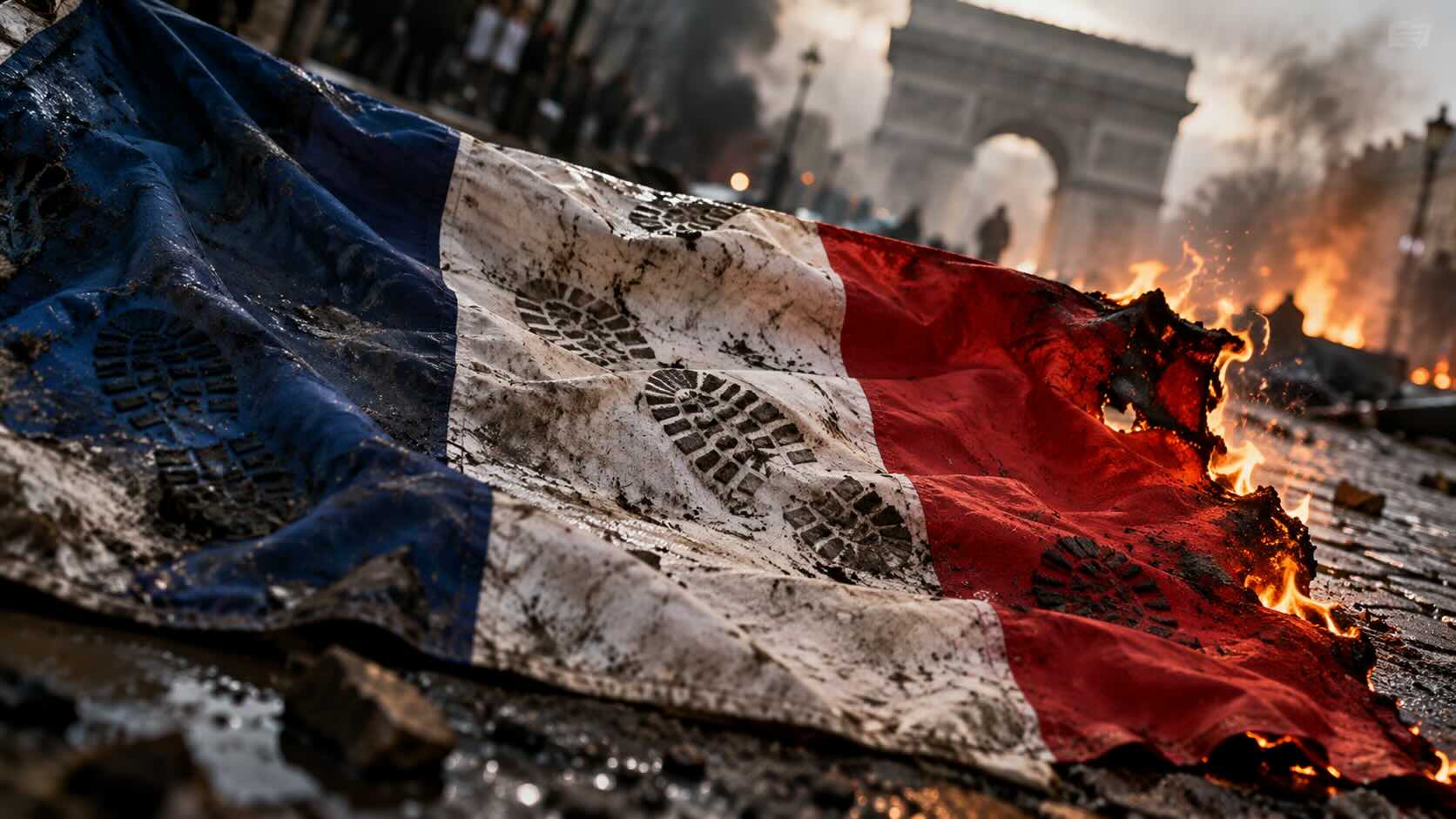
France is no stranger to political protests.
In a way, marching across cities is a deeply ingrained part of French political culture since the French Revolution. French ideas drove chance across the whole continent more than once in the last three hundred years.
Terse confrontation with police, blood, fire and vandalism are also often at play on such events, again, in accordance with the tradition, starting with the 1968 student demonstrations.
But in the last years, the demonstrations have grown increasingly violent – a powerful reminder of the deeper problems and frustration penetrating certain levels of French society.
The recent flair-up of seem to fit in the line of increasingly out-of-control protests.
They might have begun over poor school conditions (think: teacher shortages, overcrowded classrooms, and deteriorating buildings), but the event soon got hijacked by different protester groups. Demands now cover everything that’s wrong with France: inflation, high rents, cost of living, unemployment and significant cuts in public spending.
In 2016-2017, South Korean ‘Candlelight Protesters’ took to the street: there were approximately 16 million of them. Determined, but peaceful. The product of another long tradition, vastly different from France’s own method: candlelight vigils. Organized and family friendly, the perfect symbol of nonviolent civil resistance that was still enough to put pressure on the government within constitutional framework.
Now, French streets are filled with an estimated of 800,000 people. Yet, the damage caused by them is estimated to reach billions of euros. Increased violence from the protesters’ side forced the hand of the government: curfews, large-scale police deployment and the use of crowd-control weapons followed.
Given the unprecedented level of unpopularity of President Macron (last polls put him at 14 percent), he and his government doesn’t have much to lose with a drastic and disproportionate response. In fact, the extent of damage justifies the act in the eyes of many voters.
The French government fights hard to stop the opposition from linking the protests to migration.
In a way, they might not be: they are more about reflecting demographic realities than direct causation between illegal migration and violence.
But in many other ways, they are.
Unlike in South Korea, for example, one of the most homogenous nations of the world, French society is diverse. Worse, that diversity doesn’t spread uniformly in all age-groups and echelons of the society.
Younger people (and households) have very low median wealth and face slower accumulation at the same time when older generations are wealth-rich, especially in housing, as wealth gains over recent decades have disproportionately gone to the top of the distribution.
Furthermore, the social groups most severely impacted by the recent crises are not only young, but disproportionately people with migrant backgrounds.
Multiple studies confirm that immigrants face severe barriers in labour market entry: origin-based discrimination is a widely cited complaint, so is the lack of French knowledge. There were 9,700 racist, xenophobic or anti-religious offences in 2024 alone. Housing is either insufficient or aligns with long-standing patterns of spatial segregation. Reports of unequal schooling (worse conditions, fewer teachers, and lack of sufficient support to help integration) and lower access to public services match the geographic areas of housing issues.
Social inequality is a driving force behind the protests – and it affects people with different cultural backgrounds (that often translates to: immigrants) disproportionately.
While initially protesting for the same things, their demands quickly diverge, leaving the demonstrations fragmented and prone to spiral out of hand.
At this stage of the French protests, the goal no longer seems to be to improve conditions or to “guide” the state in the right direction. At least not for all of the protesters. Marginalized or segregated groups simply start to treat the state as the enemy.
France might be in a unique position as its protests have historically been more violent and confrontational than in the rest of Europe. The current wave of vandalism is also a multi-faceted event caused by the interplay of several factors. But one of those is the failed integration of immigrants.
Something the EU should monitor closely and draw the necessary conclusions before the French example gets repeated elsewhere (like it did a few times throughout history).


