
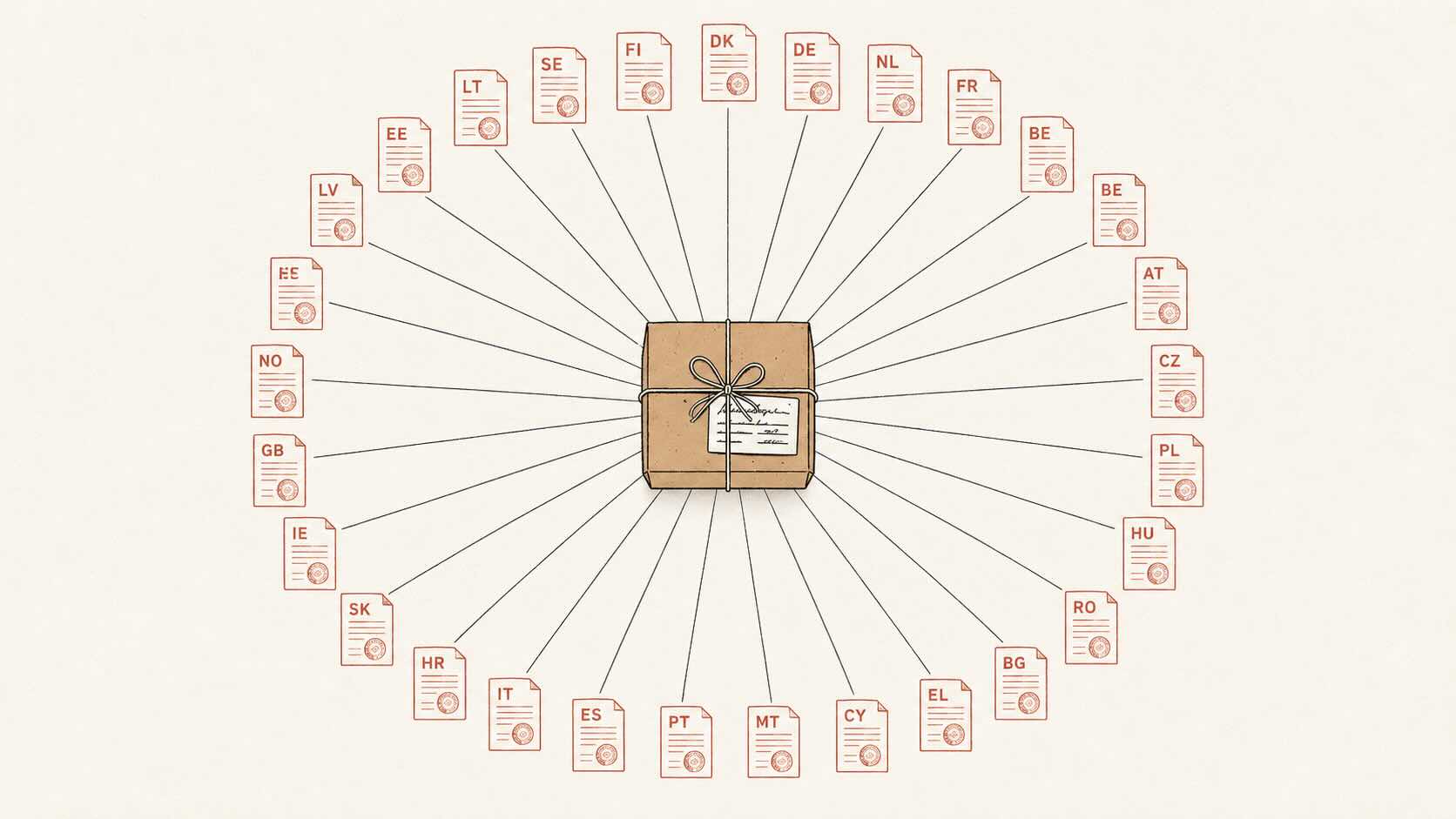
Europe’s new packaging law started applying yesterday. The idea behind it is fine. The paperwork it comes with can make posting five records to another EU country cost more in admin than the records are worth — and Brussels knew that before the law kicked in.
On 12 August 2026 the EU’s Packaging and Packaging Waste Regulation — PPWR for short, Regulation (EU) 2025/40 — started to apply. It replaces a packaging directive from 1994, and that swap matters more than it sounds. A directive gets copied into each country’s own law, which is why packaging rules looked different in every member state for thirty years. A regulation just applies, the same way, in all 27 countries, from day one. Nobody had to pass anything locally. There’s no settling-in period, and no pass for boxes you already printed.
Why it exists is easy to agree with. Packaging is one of Europe’s fastest-growing piles of waste. Plastic packaging alone is about 40% of all the plastic used in the EU, and packaging is roughly half of what ends up as litter in the sea. The law wants all packaging on the EU market to be genuinely recyclable by 2030, and it wants the businesses putting packaging out there to pay for collecting and treating it afterwards. Polluter pays, applied to cardboard. Few small sellers would argue with any of that.
The rules about the packaging itself really are the same everywhere now: one set of design requirements, one conformity document. The money is a different story. Extended Producer Responsibility — signing up, filing numbers, paying fees — is still run country by country. So the law tidied up the rules about EPR without doing anything about EPR being 27 separate systems.
The bit that catches small sellers
Everything turns on one word: producer. It means whoever first puts packaging onto a national market. If you sell in your own country, fine, that’s you and you’re already registered. If you post a parcel abroad, it gets interesting. The Commission’s own 2026 guidance confirms the reading everyone feared: a webshop sending packaged goods straight to a customer in another member state is the producer there, in the country where the box will eventually be thrown out.
So a German label posting a CD to France picks up French obligations. A record going the other way brings German ones. Austria, Italy, Finland, Portugal — each one adds another system to deal with. And under Article 45(3), if you’re not set up in the destination country, you have to formally appoint a representative who is. One per country. There’s no single EU desk that covers all of them. Sell into eight countries you’re not based in and you need eight representatives.
The obvious hope is that there’s a minimum size below which none of this applies. There isn’t. The law does offer lighter paperwork if you put under 10 tonnes of packaging a year onto a national market, which is basically every independent seller alive. But lighter paperwork doesn’t stop you being the producer, doesn’t cancel the registration, and doesn’t collapse the country-by-country structure underneath. Several national registers start at the first item.
Charging a seller for the waste it creates is fair enough. Making that seller set up shop in another country because five people there bought records is something else.
Do the maths and it falls apart
Here’s the whole problem in one line: the cost is mostly per country, not per parcel. Picture a label pressing 300 records. It sells 150 at home and scatters the rest — ten to France, six to Germany, three to Finland, two to Portugal, one to Slovenia. In Single Market terms those are just sales. For packaging law they’re separate national obligations.
You can see the price of that. One compliance firm’s published 2026 packages run from around €360 a year for Germany to €1,485 for Slovenia; add up its listed prices for all 27 countries and you’re at roughly €17,860 for a first year. Other firms charge less, and you can file some of it yourself. But the fact that an entire industry now exists to handle this tells you how much paperwork we’re talking about.
Split that per order and it stops being a rounding error:
| Orders into one country / year | Admin cost per order at €400/year |
| 20 | €20.00 |
| 5 | €80.00 |
| 1 | €400.00 |
At that point dropping the country is simply cheaper than selling into it, and sellers have already worked this out. The German shops Pikecraft and Valkyrie Parts have cut destinations and said PPWR is why. Betta Botanicals, in the US, stopped shipping to the EU entirely. None of them are dodging the law. They read it and left.
Brussels tried to undo its own rule
This wasn’t slipped in at the last minute by anyone. The cross-border representative requirement was in the Commission’s original 2022 proposal, as Article 40(2), and survived the renumbering to become Article 45. Parliament passed the package on 24 April 2024, 476 votes to 129 with 24 abstentions. The Council signed it off on 16 December 2024, with 26 countries in favour and one against — Slovakia.
Then, on 10 December 2025, the Commission published a proposal to switch that very requirement off until 1 January 2035, as part of a simplification package. Its reasoning: patchwork EPR rules get in the way of cross-border trade inside the Single Market. In other words, the people who wrote the provision had decided, in public, that it obstructs the market they were legislating for.
No relief arrived. The pause was only ever drafted for businesses based inside the EU selling into another member state, so sellers from outside the EU were never covered. And on 24 June 2026 the Council said talks on the EPR part had been dropped after most member states objected. Parliament’s environment committee is working on a narrower version for micro and small firms, with a vote expected around October — about seven weeks after the rule it would soften started to bite. So the law arrived on schedule with a known fault and no fix.
Enforced at the checkout, not by inspectors
Most sellers will never hear from a regulator. They’ll hear from a marketplace. The Digital Services Act makes online platforms check seller details against public registers, and the packaging register counts as one. Amazon.de, Cdiscount and Bol.com already block listings without a valid packaging registration number. Marketplaces and fulfilment firms now check it the way they check a VAT number.
Where authorities do get involved, the numbers are serious: immediate sales bans in Germany plus fines up to €100,000 for unregistered producers, up to €600,000 in Spain, and in Ireland penalties running to €15 million with prison on the books. Meanwhile the one thing that would make all this easier — a shared data format so the 27 registers ask for the same information, which the Commission was supposed to publish by February 2026 — still hasn’t appeared. Sellers are being held to a single standard that isn’t single yet.
What the sellers themselves say
The sharpest description of all this hasn’t come from a trade body. It’s a petition to the Commission and Parliament, “Stop destroying EU micro-businesses: Immediate moratorium on cross-border EPR fees,” started on 6 August 2026 by Jeanette Koñarčíková, an independent artist and micro-entrepreneur from Slovakia — the one country that voted against the regulation. It passed 54,000 verified signatures inside a week, more than 7,000 of them on 13 August alone.
Its first line does the job better than any impact assessment: “The Single Market is broken for small creators.” It’s now easier, the petition argues, to post something to the other side of the world than to the country next door. On the fees it’s blunter still: “This system does not protect small businesses — it destroys them.” Big firms pay fractions of a cent per parcel. Someone sending five handmade items pays hundreds, just to do it legally.
Two of its points deserve repeating. First, a correction: the widely shared belief that small businesses are exempt is wrong, and the petition calls that misinformation dangerous. The law bites from the first gram of packaging and the first parcel sent abroad. That reading is right — the 10-tonne rule lightens the reporting, not the obligation. Second, the part that stings: the sellers priced out are often the small, local, low-volume ones, while high-volume packagers pay the fee and carry on. It lands hardest on rural and self-employed makers whose home market is too small to live on.
The petition asks for three things — a freeze on cross-border registration and representative fees for micro-businesses while the law is reformed, an EU-wide minimum size below which none of this applies, and a real one-stop shop so nobody registers 27 times. A formal version has also gone to Parliament’s petitions committee. The striking part isn’t the anger. It’s that what the artisans are asking for, what the law’s own logic suggests, and what the Commission itself proposed last December are all roughly the same three fixes.
Same rule, very different results
On paper PPWR treats Amazon and a two-person label identically. That’s exactly what’s wrong with it. A fixed cost per country disappears into millions of parcels; the same cost, spread over three customers, is a decision to stop selling. Treating wildly different businesses the same way doesn’t produce fairness, it produces fewer sellers. And when a mail order pulls out, nothing is saved: the customer buys the same record from a bigger shop, in the same cardboard.
You don’t have to scrap producer responsibility to fix this. You just have to make the admin scale the way the environmental logic does. One registration valid across the EU, with the fees divided between national schemes. Or a floor below which the destination country’s machinery doesn’t switch on. Or, at the very least, publish the shared data format that’s already overdue so one filing can serve 27 registers. The analysis exists — the Commission wrote it down in December. What’s missing is the will to finish the job before the smallest sellers finish leaving.
Europe spent forty years making it not matter which country your customer lives in. As of yesterday, for a €20 CD, it matters again — in the name of a recycling target a better-designed rule would have hit just as well.
Sources
- Regulation (EU) 2025/40 (PPWR), Articles 44 and 45 — EUR-Lex.
- European Commission, guidance document on the Packaging and Packaging Waste Regulation, March 2026 (C/2026/3084).
- COM(2025) 982 of 10 December 2025, Environmental Omnibus package, Article 2.
- Council of the EU, press release of 24 June 2026 on the environmental simplification negotiating stance.
- European Parliament, plenary vote of 24 April 2024; Council adoption of 16 December 2024.
- Side-Line, “The EU commission killed the indie mailorders as of today,” 12 August 2026 — per-country pricing, seller withdrawals.
- “Stop destroying EU micro-businesses: Immediate moratorium on cross-border EPR fees,” Change.org petition started 6 August 2026 by Jeanette Koñarčíková; signature counts as of 13 August 2026.
- Regulation (EU) 2022/2065 (Digital Services Act), Article 30; national penalty ranges as reported by compliance practitioners, August 2026.


