
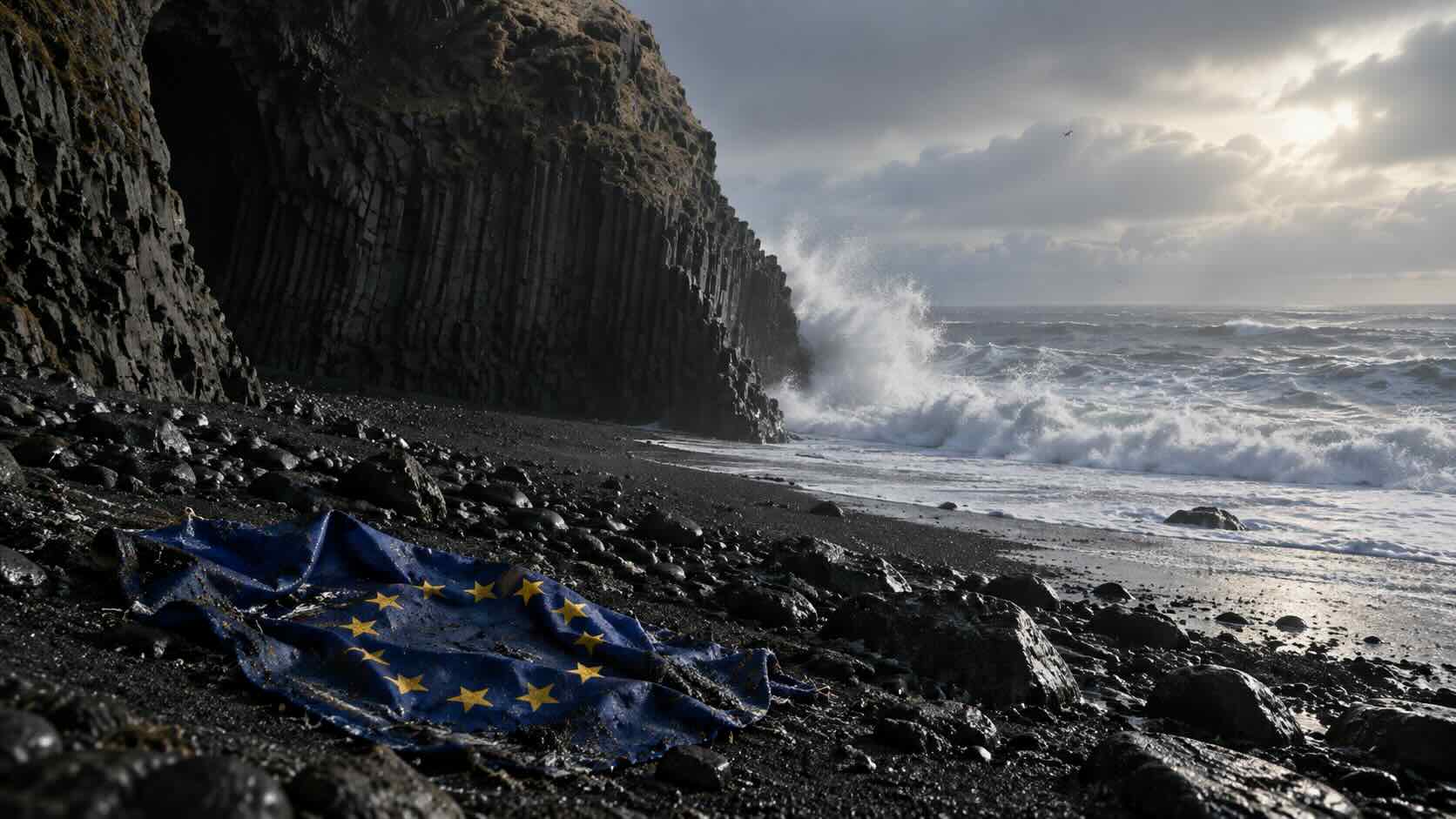
There’s been many back-and-forth-s about why Iceland’s population voted against EU accession, effectively closing the door on membership. Even if with a narrow margin: 52.8 percent voting against and 47.2 percent for an eventual accession (with a whopping 82.5 percent turnout).
But there’s one reason that’s not discussed enough.
That is: The EU failed to present itself as a stable power guarantor in the new volatile world.
To be fair, in the vote burdened with layers of historical relations, unique situations and actual geopolitical developments, the country’s capital-countryside split became painfully obvious. (Again.) Only Reykjavík’s two central areas voted “yes”; rural areas and Reykjavík suburbs voted “no”.
Two political circumstances have shaped Iceland’s current status quo before the crucial vote.
The first is related to defense and security. Iceland is the only founding member of NATO that has no military forces—no army, navy, or air force. The 1951 bilateral defense agreement with the United States establishes that Washington is responsible for Iceland’s defense within the NATO framework. From a security point of view, this means that the U.S. provides Iceland with defense and has access to Icelandic territory. Iceland offers its strategically important geopolitical location, which is becoming significant as the Arctic keeps changing.
The second issue is cooperation with the EU. Iceland has been part of the European Economic Area since 1994 (with Norway and Liechtenstein). This setup gives it access to the EU’s internal market and its four freedoms: goods, services, capital, and people.
Economically, this is substantial: the EU accounted for over half of Iceland’s goods trade in 2025, representing about two-thirds of Iceland’s exports and just under half of its imports. Roughly three-quarters of Icelandic export firms sell into the EU.
Iceland is linked to the EU in many other ways, as well.
It’s part of the Schengen border‑free travel area and cooperates on related security and police matters. It also participates in the Dublin system for asylum responsibility, aligning with EU rules on processing asylum claims; and other major EU programs such as Horizon Europe and Erasmus+.
But Iceland is not in the EU customs union, does not use the euro, and has no seats in the European Parliament or Commission. This setup enables the country to have tariff-free access to the Single Market and to pursue independent trade deals with other countries through EFTA/EEA channels without being bound by the EU’s common commercial policy to the same extent as members.
It exempts Iceland from EU fisheries rules, as well. (A great deal of the campaign before the vote was centered around this problem.) Thus, Reykjavik can have its own independent fisheries policy, including quotas and access rules, which is politically non-negotiable for many voters and important to a large share of Iceland’s exports.
The No campaign’s central message was that EU membership could force Iceland to cede control over its fishing quotas and open its waters under the EU’s Common Fisheries Policy.
Fishing is Iceland’s economic lifeline.
Voters treated the potential loss of control as an unacceptable risk, even though the referendum was only about restarting talks. Concerns about the EU’s Common Agricultural Policy also featured in regional opposition.
The reality is that in this moment, Iceland enjoys a balanced status quo between the US and the EU.
It can collect the strongest benefits from both sides. For a country that placed its safety in the hands of the US, any shift would be more than just an economic or value-based decision. It is and will always be a strategic decision influencing everything else. The current position will be changed only with enough motivation.
Though the “Yes” campaign emphasized that the EU accession doesn’t mean abandoning American security guarantees – in practice it would still mean tilting towards Brussels.
The campaign might had been predominantly focused on the economy. Fishermen’s businesses were probably the main decision makers, indeed. But geopolitics played an important rule in the background, even if neither side made it in the focus of their campaign.
In fact, it might have happened that geopolitics was actually strengthening the “No” camp to maintain the precious status quo.
Prime Minister Kristrún Frostadóttir’s government brought the vote forward, citing international tensions, including US President Donald Trump’s threats against Greenland, to argue for stronger European anchoring. In the final days, the government even played “the Trump card” – but polling consistently showed “No” gaining traction.
From the EU’s point of view this translates to a simple message: the Union was not able to present itself as a credible major power that could provide hard guarantees in a turbulent world. Not even with the current unpredictable state of Washington’s ad hoc foreign policy – one that doesn’t spare foes or allies. The EU is still not considered strong enough to offer alternatives.
So, for now, Iceland’s accession is off the table.
Pro-EU politicians and EU officials both emphasized continuity, trying to send the message “nothing to see here, people, move on”. The European Commission said it “takes note” and respects the choice. Iceland’s government pledged to deepen ties through the EEA. The US state department stated nearly the same.
But Iceland’s unchanged position is a proof that the EU was very close to gaining a strategic victory point after President Trump’s Greenland-act – yet it failed to score it.


