
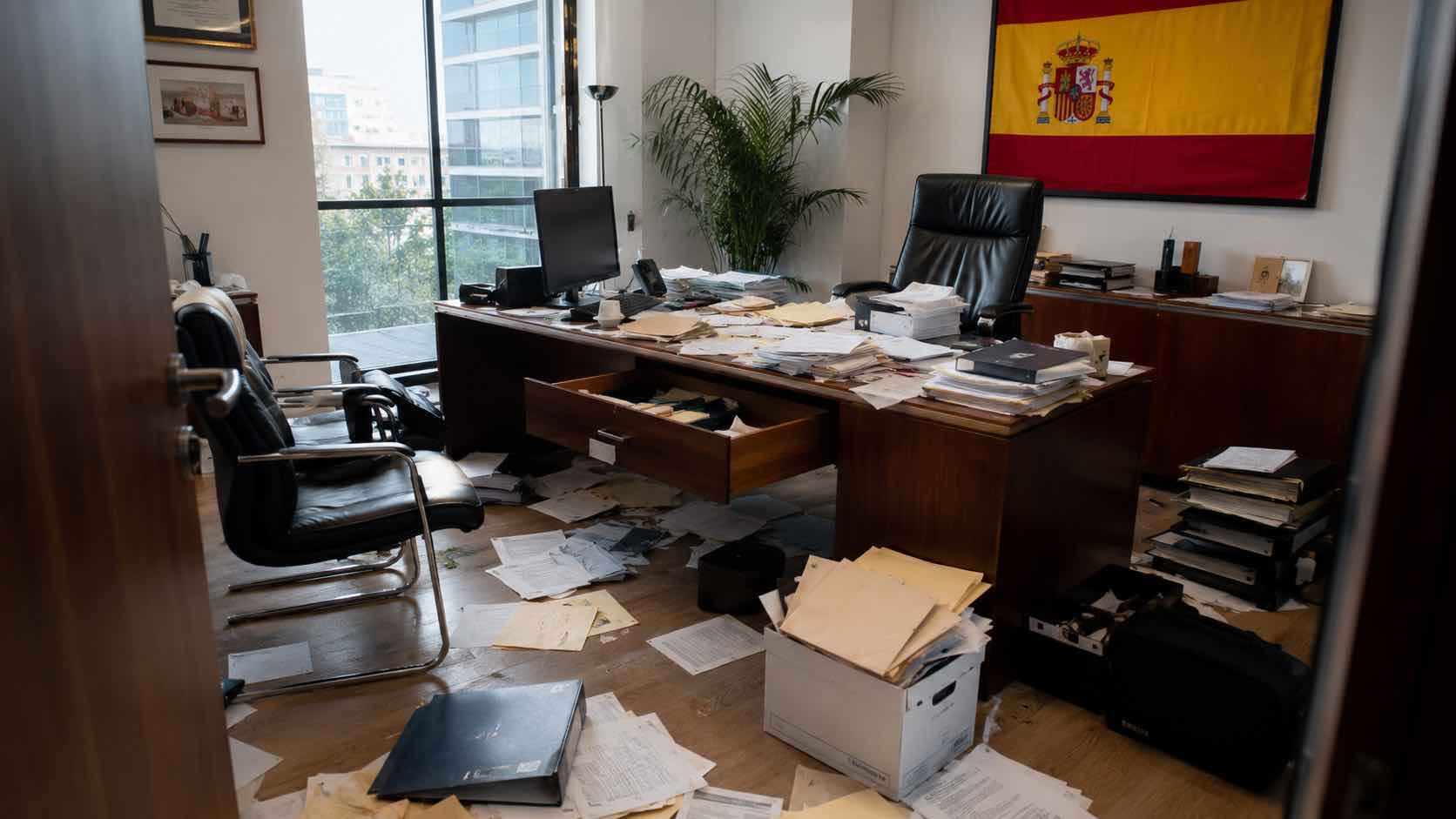
On May 27, 2026, police officers entered the Madrid headquarters of PM Pedro Sánchez’s PSOE. Under orders from National Court judge Santiago Pedraz, they hoped to find documentation and electronic files about a potential illegal payments scheme.
If there was a bad moment for a step like this – it’s now. At least for Sánchez.
The latest anti-government protest in Madrid, driven mostly by the growing anger about the never-ending list of corruption allegations, saw tens of thousands attending.
While the latest scandal is not much different from the previous ones – the Koldo Case, the Ábalos Affair, the Santos Cerdán allegations, the Begona Gómez Investigation or the David Sánchez Investigation, it adds more fuel to the fire already burning around the prime minister.
All the above cases involve PM Sánchez’s innermost circles: his closest advisors or family members. Like former PM José Luis Rodríguez Zapatero, one of Sánchez’s key allies, who was indicted just days ago.
In this latest case, PSOE officials are alleged to have spent tens of thousands of euros commissioning individuals to discredit the critics of the government and the prime minister. Among the accused is Leire Díez, another PSOE functionary close to Sánchez.
Even if corruption scandals are hardly unique to the PSOE government – the frequency is obviously too much for Spanish voters.
And they’ve already proved once that corruption scandals can bring down governments: the conservative People’s Party (PP) spent years damaged by the Gürtel scandal, Bárcenas affair, and multiple regional corruption cases.
At least this seems to be constant in Spanish politics.
Housing market? Economy? Institutions? Not that much stability there.
Yet, corruption scandals seem to be just as much part of the national ecosystem as the endless olive tree fields.
It doesn’t absolve the PSOE, though.
The latest demonstrations against Pedro Sánchez and the Socialist government were presented as a patriotic uprising against corruption. Except, there’s not much difference between the sides of the political spectrum.
The PP is now portraying itself as the better alternative, because ‘Sánchez’s government stinks of corruption’, as party leader Alberto Nunez Feijoo said. The PP has repeatedly called for early elections.
But Sánchez’s coalition partners are also increasingly worried about the possible backlash caused by the growing list of scandals.
The government is not collapsing just yet, but tensions are no longer simmering ‘only’ under the surface as each minority partner assesses how long they stick to Sánchez before they also become collaterals.
Among them, PNV is the most likely to walk away if the spiral of scandals doesn’t end.
In fact, party president Aitor Esteban publicly stated that it would be ‘irresponsible’ for Sánchez to try to govern beyond 2026 given the judicial chaos, lack of stable majority and political paralysis. In his view, the situation was ‘very serious and very worrying’ after Zapatero’s indictment. The party also demands that the PSOE give real explanations to the scandals, beyond the ‘lawfare’ excuse often used by Sánchez.
As PNV is both the most moderate and most predictable of Sánchez’s short list of allies – when they start talking about the government’s sustainability, that’s a sign.
For now, Sánchez insists he won’t call early elections and intends to stay in office until August 2027.
And as long all of his political partners stay on his side, he can – thanks to the Spanish ‘all-or-nothing’ regulations on vote of no confidence, chances are low that he can be removed from his position. Likely even if his minority partners withdraw their support – in the current climate, it’s unlikely that the parties could come up with a replacement candidate.
On the other hand, every new scandal pushes Spain further down the road towards instability in a slow-motion political novela.


