
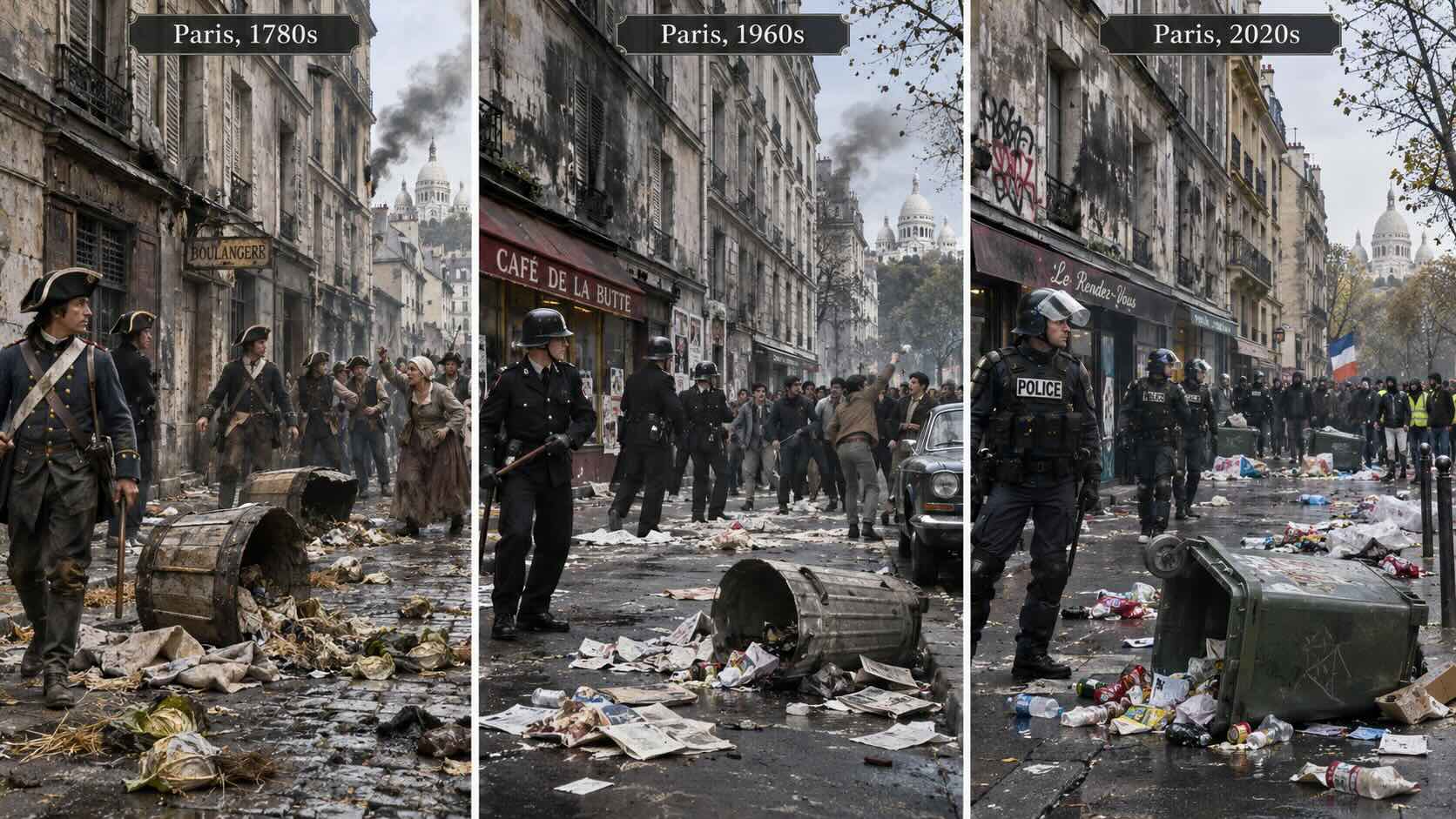
A Long-Standing Tradition Of A Protesting Nation Or A Typical Sign Of The West’s Decline?
According to the core (and deeply fatalistic) concept of the German author Oswald Spengler’s famous book titled ’The Decline of the West’, civilizations – the second and final phase of living which comes after the creative and flourishing phase of culture – follow a predictable cycle which consists of inevitable phases. In this sense, civilization is considered the final, rigid phase of a dying culture.
This is exactly what one might think first when looking at the mass street protests in France, with more than 400,000 people nationwide taking part. However, given that these protests are taking place in a country which is known for its vibrant protest culture, where protesting is considered a social duty and part of the national identity, this raises the question of whether the recent events in France comply with the local traditions and can therefore be regarded as a typical sign of democracy or, instead, such a violent development of the situation does not fit with the French traditions at all and should be taken as a warning, indicating the country’s decline.
Using Oswald Spengler’s key concept as a starting point, in today’s post, a further question arises as to whether French migration rules and policies have themselves paved the way for such a violent outcome.
Many blame the banlieues
To highlight the key importance of the above question, let’s start with noting that the deep social problems in France’s banlieues – suburbs of big cities inhabited by immigrants, primarily from ex-colonies like Algeria and Tunesia – such as pervasive poverty, soaring crime rates and increasing social tensions have been known for decades.
One of the biggest challenges in France, in particular in the banlieues is that the generous French system of social benefits has resulted in immigrant communities’ dependence on these payments. Considering that many young people in these communities are unskilled, they usually face difficulties to find a job. Given this, whole generations in these communities grow up without even entering the French labour market.
According to studies, people in the banlieues often reject the French lifestyle and France’s core values. A study by the French polling institute IFOP last year indicated a significant shift among young Muslims in France, with many expressing stronger adherence to Islamic law over the country’s republican principles. The findings portray a community undergoing a ’re-Islamization’, with increasing mosque attendance, hijab use and strict fasting during Ramadan. IFOP estimates Muslims constitute about 7% of the French population.
Despite the issue of the banlieues has been a ’hot potato’ in France for a couple of decades, President Macron pretends as if he has never heard anything about it. Moreover, comments on the riots in France from foreign leaders – including US President Donald Trump, Poland’s Donald Tusk and Hungary’s Peter Magyar who linked the protests with migration and spoke about hordes of migrants and Islamists in French cities – really annoyed him. He called these comments ’stupid’ and ’unacceptable’.
About Macron’s responsibility
The fact that President Macron denies any link between his country’s migration policy and the recent unrest can be considered a real headache not only for France but the EU as a whole, given that the issue of migration has not only contributed to increasing tensions in France but been a key driver behind the protests. While everything and everyone, including the French people, tells us that France’s immigration policy is unsustainable, Paris refuses to accept it.
The French politicians’ attitude is difficult to understand, especially as some national governments across Europe have just entered a promising new phase of political awakening and recognised that the French model of integration is troubled by deep-rooted problems, and has serious shortcomings such as the mass influx of people with different cultural backgrounds coupled with the lack of integration, leads to a situation that is pretty much impossible to resolve. (France has a republican model of integration, built on the universalist values of the 1789 Revolution of secularism and equal individual rights for all. Recognition of cultural difference or ethnic communities is considered unacceptable.)Social Exclusion and Labour Rights in the Banlieues of Paris – Centre for Urban Research on Austerity
Even at EU level, the general principle of the necessity of moving towards stricter migration measures and rules has been recognized, accepted and included in the Pact on Migration and Asylum, first and foremost in order to protect the interests of European citizens and their living standards, as well as to ensure long-term sustainability in the area of migration.
The responsibility of the French president and the government is unavoidable as they have not paid enough attention to the root causes.Long-term social tensions, high rates of unemployment, inequalities in France’s education system, poor living conditions and bad healthcare services together can be named as causes that led to a wave of protests and demonstrations across France. What started as student protests soon expanded from education to other painful areas and turned into anti-government protests which led to clashes with police.
’For young people from the suburbs, the riot is one of the traditional forms of collective expression,’ political scientist Fabien Jobard said.
With regard to this explanation, it should be stressed that people from various groups expressed their frustration and, given the French head-in-the-sand attitude, closing the gap between them seems to be impossible as promoting a spirit of inclusion is not enough anymore. This is one of the key messages of the disturbances in France. The other one is, that when the concentration of poverty is coupled with inaction from the state, it inevitably leads to situations we can see in France.
Emmanuel Macron criticised foreign leaders saying they use the unrest in France to justify their countries’ hard-line policies on immigration. Given the French president’s annoyed and frustrated comments, he seems to forget about his own role in the large-scale dissatisfaction among his nation, from students to immigrants. Macron did not even understand – or simply did not want to – why the protests turned violent.
Both the French president and the government accused ’troublemakers from far-left’ of driving the unrest. Given how much the French leadership has been mismanaging and underestimating the protests, it is only paving the way to Marine Le Pen and her far-right National Rally to pitch herself as the candidate of an ’appeased France’. The protesters had ’legitimate social demands,’ Le Pen said.
Lessons learned from the riots in France
With lessons learned from the case of France, European countries need to abandon their old migration and integration policies. In order to Europe remain that great place and culture it used to be, stricter rules on migration are needed.
As part of a new approach, governments should make it clear that social payments should not be an automatic lifetime source of income, but they are a short-term support that is conditional on learning the local language, doing something useful for the country and, having a job. Unless newcomers agree on it, their social payments must be reduced or even revoked.
Similarly, given that many Muslims in France fully reject integration and, the French lifestyle and France’s values in general, it is time for Paris and the whole of Europe to understand that without any willingness on the part of the immigrants to be integrated, efforts by the national governments alone will be ineffective.
It is also necessary to understand that citizenship alone creates neither national identity nor loyalty to the nation. As the case of France shows, it would be essential for European countries to introduce value-based immigration policies and enforce legally binding new integration models where accepting the host country’s core values needs to be a must. Those who reject European values on religious or any other grounds, should be exluded from the integration process and send back to their country of origin. If an immigrant with residence permit in a European country poses a threat to national security, his or her residence permit should be immediately revoked and the individual must be expelled from the country.
At the same time, in line with the new Danish law on ’no-go zones’, preventing the forming of geographical and social ghettos – that is, zones where people with a non-European background form the majority – would be key in the interests of both immigrants and locals, given that such situations can undermine integration. Separatism and a ’ghettoization’ of a country, a district or a school must be avoided.
Returning to our starting point and, to summarise the above, it is important to emphasise that the French model of immigration and integration has, in fact, failed and its failure has paved the way to the current nationwide unrest. At the same time, it would be too early to speak about the ’decline of the West’ or, ’decline of France’. With stricter migration rules and wiser integration policies which do not allow inequalities but provide phsysical and financial security for every single citizen, European culture and civilization will continue to flourish.


